

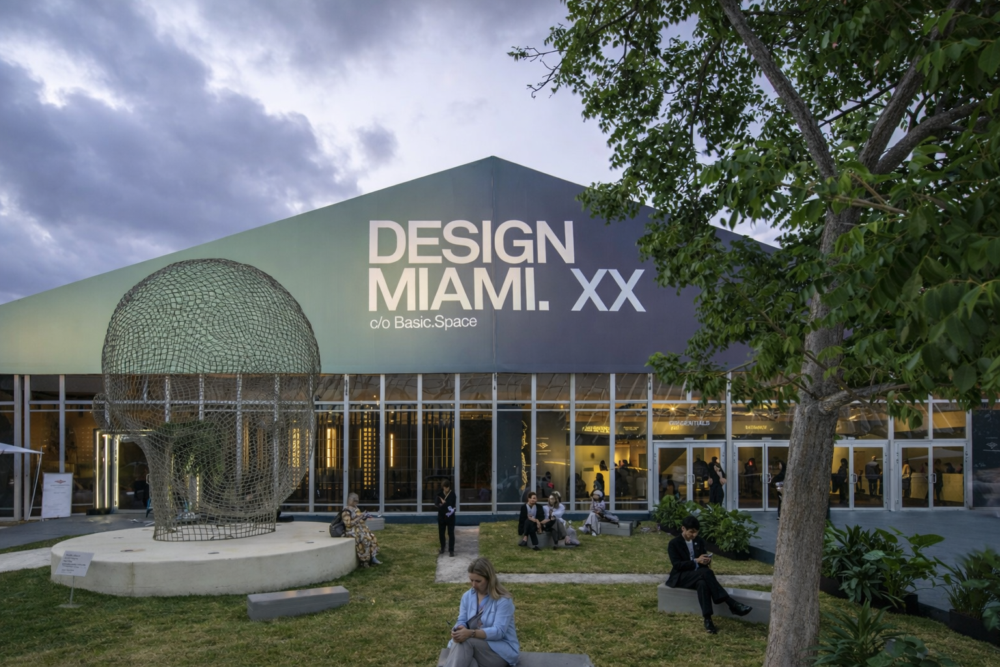

Furniture fair Design Miami revealed a strong presence of designers drawing on non-Western traditions, organic materials, and indigenous knowledge systems.
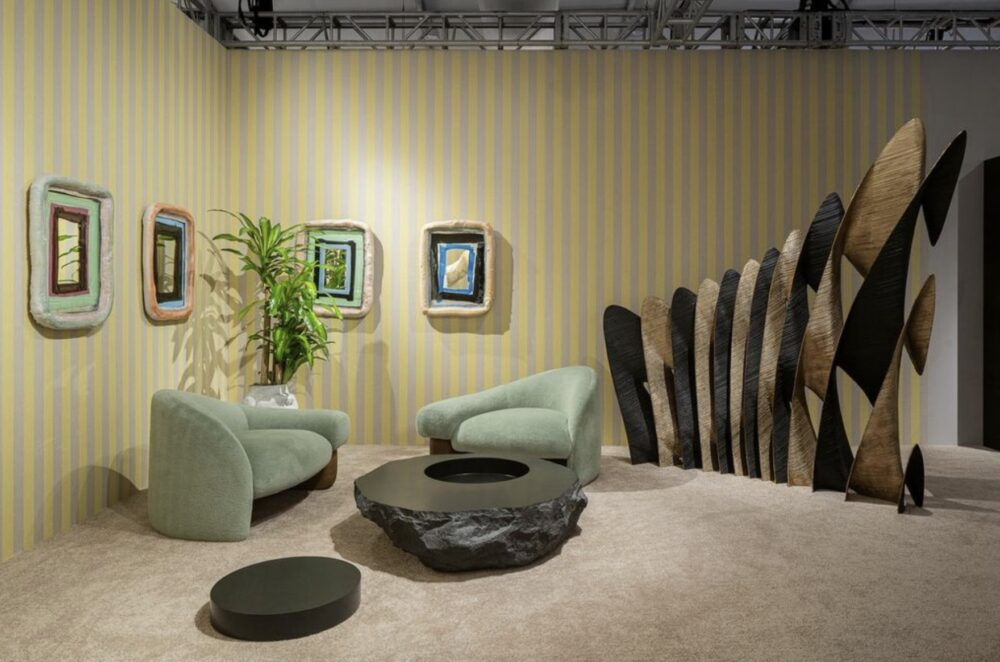
One of the most striking and genuinely refreshing aspects of this year’s Design Miami was its clear departure from the rigid, rectilinear linearity that has long defined Modernist furniture. Instead of cold geometry and industrial restraint, many of the most compelling works embraced rounded forms, tactile surfaces, and an almost surreal sense of play. These pieces felt whimsical, dreamlike, and sometimes even otherworldly, reflecting a broader cultural turn toward imagination, storytelling, and emotional resonance in contemporary design.
This shift was entirely in keeping with the fair’s overarching theme, Make. Believe., as well as with the tone of its panel discussions, including the aptly titled “The Alchemy of Making: From Imagination to Innovation.” Across the fair, furniture increasingly behaved like sculpture, and design increasingly overlapped with ritual, spirituality, and environmental consciousness. Nowhere was this more evident than in the strong presence of designers drawing on non-Western traditions, organic materials, and indigenous knowledge systems—often reframing them through highly contemporary lenses.
Below, three key currents from Design Miami reveal how global perspectives and organic thinking are reshaping collectible design today.
Furniture as Portal: Roham Shamekh and the Spiritual Sofa
Among the most talked-about debuts at the fair was a sinuous, sculptural sofa by Dubai-based artist-designer Roham Shamekh. Part of his Roots collection, the ghostly, shimmering white sofa—retailing for $160,000—looked as though it belonged in the decaying grandeur of Miss Havisham’s mansion from Charles Dickens’ Great Expectations. Yet its conceptual ambitions extended far beyond literary reference.
Every aspect of this one-of-a-kind piece was singular, from its hybrid construction to its immersive sensory dimension. The base and arms were fabricated from epoxy resin fused with melted aluminum, while the seat was overlaid with silk fabric, creating a surface that appeared both delicate and otherworldly. More installation than conventional furniture, the sofa also incorporated the Roots Soundscape,a curated audio experience of forest ambiance and New Age tonalities. Visitors could listen through audiophile-grade headphones while seated, effectively transforming the act of sitting into a contemplative ritual.
Shamekh’s ambitions, however, go well beyond aesthetics or comfort. According to the accompanying wall text, sitting on the sofa while listening to the Roots Soundscape is intended to “harmonize the body’s nervous system, calming the mind and cultivating a sense of balance, peace, and safety—the core essence of our collective roots.” It is a cosmic vision of furniture as a therapeutic and spiritual tool, one that challenges deeply ingrained assumptions about what a sofa is supposed to do.
In this sense, Shamekh’s work exemplifies a broader trend at Design Miami: designers who operate fluidly between art, architecture, and philosophy, producing objects that seek not only to shape space but also to recalibrate human experience.
Organic Experiments: Mexican Design and Material Innovation
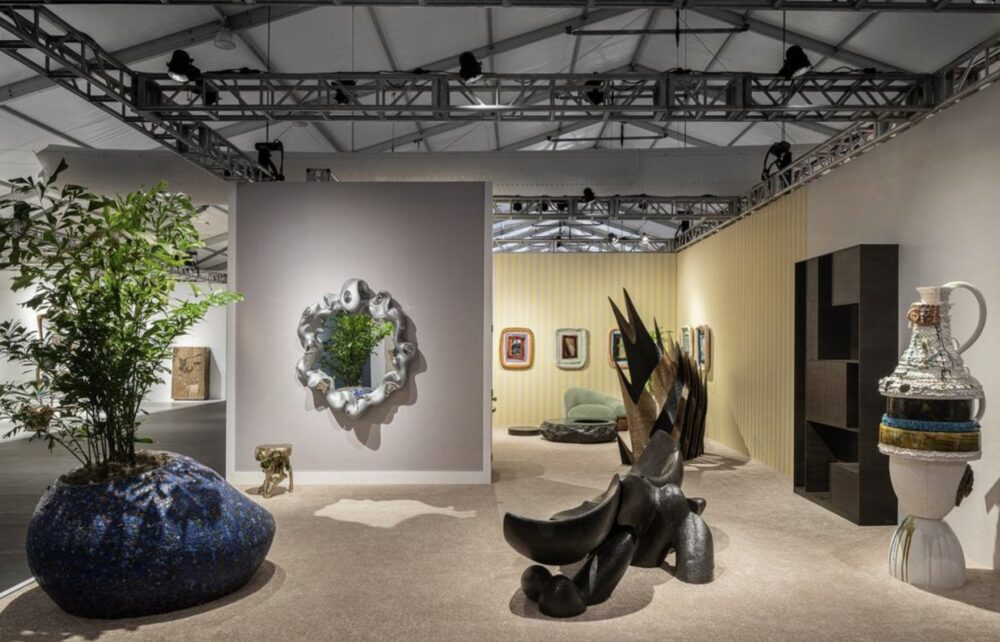
New York City–based gallery Friedman Benda presented a vibrant selection of playful and materially adventurous works, many of them by Mexican designers deeply engaged with organic processes and local traditions. Among the most eye-catching were a pair of so-called “monster lamps” by Fernando Laposse. Titled Patachon and Patachin, these furry, anthropomorphic figures featured illuminated body parts and were constructed from a mix of agave fibers, 3D-printed components, woven palma, beechwood, and brass.
The lamps exemplify Laposse’s extensive research into nontraditional organic materials, particularly agave, which is abundant in Mexico but often discarded as agricultural waste. By transforming this byproduct into tactile, expressive design objects, Laposse merges sustainability with narrative whimsy, creating pieces that feel at once ancient and futuristic.
Another standout from Friedman Benda was Tecomateis, a large-scale circular planter with integrated seating by Mexican architect Javier Senosiain. Designed to allow a person to sit directly beneath a living tree, the work invites a literal and symbolic reconnection with nature. Fabricated in Senosiain’s signature reinforced concrete and finished with mosaic tiles in varying shades of blue and green, Tecomateis embodies his long-standing commitment to organic architecture.
Senosiain, who founded the firm Arquitectura Orgánica, is renowned for his biomorphic buildings and for incorporating traditional Mexican materials and artistic traditions into contemporary design. This planter-seating hybrid could easily inhabit one of the undulating, cave-like structures he has designed throughout his career. At Design Miami, it served as a reminder that furniture can be both functional and ecological, framing nature not as decoration but as an active participant in design.
Carved Histories: Laura Facey and Monumental Jamaican Craft
Perhaps the most arresting works at the fair were presented by Todd Merrill Studio: monumental furniture-sculptures by Jamaican artist Laura Facey. The centerpiece was Cloudbench, an enormous couch crafted from raspberry-painted cedar, featuring a cocoon-like back carved from a single tree trunk. Exhibited by Todd Merill Studio, this organic mass rested atop a rectilinear base overflowing with gold leaf, which appeared to drip down onto the seat like molten light.
Facey, who has worked for decades from a studio in a rural Jamaican village, has only recently achieved widespread international recognition, notably with her powerful sculpture Redemption Song (2023), commissioned for Emancipation Park in Kingston. Her work consistently addresses themes of enslavement, emancipation, resilience, and collective trauma—subjects that resonate deeply within Caribbean history and beyond.
Flanking Cloudbench were two equally imposing sculptures: Abeng, a refuge-like form large enough to shelter a human body, and Beryl, an anthropomorphic figure perched on a substantial brown base, its silhouette echoing African sculptural traditions. Both works, like Cloudbench, were carved entirely by hand in Facey’s Jamaican studio using chainsaws, grinders, and sanding discs, then finished with vivid pigment and gold leaf.
What makes Facey’s work so intense and transcendent is not only its scale but also its synthesis of raw, organic form with radiant, almost sacred color. The pieces feel rooted in place and history, yet unmistakably contemporary—objects that function as furniture while carrying the weight of memory and myth.
A Rebuttal to the Generic
Taken together, these works underscore how the most compelling furniture at Design Miami this year transported viewers to different regions, cultures, and ways of thinking. Far from generic, mass-produced design, these pieces function as storytellers and cultural emissaries. Designers like Shamekh, Senosiain, Laposse, and Facey are quietly but forcefully rebutting the legacy of Modernism’s neutrality, offering instead objects that are emotional, political, spiritual, and ecological.
In doing so, they also reaffirm the idea of collectible design as heirloom—objects imbued with meaning and craftsmanship from the moment they leave the atelier. At a time when so much furniture feels disposable and anonymous, Design Miami reminded us that design, at its best, can still carry roots, memory, and belief.