


In our interview with Guy Ailion, co-founder and CEO of Mattoboard, we learn what Mattoboard’s findings mean for the future of creative AI in interior design.
In a hurry? Here are the key points to know:
- AI should amplify—not replace—the “Great Creative Mess.” AI must be designed to support that messy process rather than tidy it up.
- Originality is shifting from invention to discernment. Taste and editing—not novelty—are becoming the true differentiators for designers.
- Emotional intelligence will define the next generation of design AI. Use trained AI that understands emotional language like “quiet strength” or “playful warmth.”
- The AI-native design studio will blend human intuition with swarms of AI tools. Designers won’t be replaced. They’ll orchestrate AI agents.
- Context-aware AI is the next frontier. Future systems will understand space, culture, budget, personality, and narrative to enable hyper-specific, client-aligned design recommendations.
As artificial intelligence reshapes creative industries, few areas face a more intriguing paradox than interior design—where digital efficiency meets deeply human expression. Mattoboard, the platform digitizing the design studio through virtual 3D material sampling and AI-powered curation, has just released The State of AI & Interior Design Report, a first-of-its-kind global study revealing that while over 80% of designers now use AI in their practice, concerns about originality and ethical integrity remain pervasive.
To unpack what these findings mean for the future of creative AI and the evolving role of designers, we spoke with Guy Ailion, co-founder and CEO of Mattoboard, whose vision for “AI-native design” seeks to bridge the gap between human intuition and machine intelligence across the entire design workflow.
The “Great Creative Mess” and Redefining Originality
ArchiExpo e-Magazine: How do you design AI systems that enhance that mess rather than sanitize it into predictable outputs?
Guy Ailion: Most AI systems today prioritize neatness over nuance. They aim to resolve, to finish, to tidy up. But creativity doesn’t work like that. It thrives in tension, ambiguity, contradiction. The Great Creative Mess is the essential zone where ideas clash, mutate, and get stronger. It’s our discards and deviations of the work, it’s the sticky notes, the ‘final_final’ folders, and the screenshots you never look at again. Performing the Great Creative Mess is actually where flow happens. So more mess is a good thing, not a bad thing.
At Mattoboard, we aim to build design tools that don’t try to shortcut that mess—they sit inside it. Instead of one-shot results, we’re aiming to design for loops: discovery, friction, iteration. We call this “design stream thinking”—where ideas evolve in real time, with the designer steering. Here’s how I think about it: if creativity is a forest, AI shouldn’t clear the path—it should hand you a torch and say: go explore.
ArchiExpo e-Magazine: The report reveals widespread fear about AI-driven homogeneity. From your vantage point, how should the industry redefine originality in an era when algorithms increasingly co-create with humans?
Guy Ailion: Putting aside the fact that nothing is truly original, then, in a world of endless choices and infinite AI slop, the designer becomes a curator of meaning, not a manufacturer of novelty. When you can generate every idea, image, video, thought, book, etc., the bottleneck is no longer imagination—it’s selection.
And this is where taste becomes a moat. Anyone can generate. But few can edit. Few can know what to keep. Discernment is a form of editing, and taste is a form of editing. But taste is constantly evolving every generation, so the skill of originality will be having your pulse on what is meaningful to other people and creating that.
Until it changes again, and you change again.
I also think there will be a pendulum swing to something I call ‘raw taste’ or ‘slow taste’, which is documenting man-made flaws in the process of making. Because when output is easy, the process may well be where most of us find meaning. So the story of how something is made may give it more ‘original’ vibes than what it is or looks like.
The Data Behind Design and the Emotional Layer of Design
ArchiExpo e-Magazine: Interior design is as much emotional as it is visual. How close are we to AI systems that can interpret or respond to the emotional intentions behind a design concept, not just its functional or aesthetic parameters?
Guy Ailion: Right now, most AI understands form, texture, or keywords. But emotion lives in subtext. It’s rhythm, juxtaposition, and restraint. This is where humans have the edge. Emotion is meaning, and humans decide what meaning is.
At Mattoboard, we’re working on ways to capture emotional language more directly—using terms like “quiet strength” or “playful warmth”—and teaching the system to recognize the material patterns that evoke those moods. It’s not just “mid-century wood table,” it’s “confidence with softness.” We do this because this is the language of interior designers. We need to translate that into selections of materials.
But true emotional intelligence in design AI won’t just be created in their outputs. It will be about dialogue. Dialogue is the closest it will get to simulating emotional intelligence. The keyword is simulate. It will ask: “Why this?”, “How should this space make someone feel?” That’s the future we’re building toward. And it’s more helpful for the designer to think through those questions.
AI as a Design Colleague and Shifting Pedagogy
ArchiExpo e-Magazine: What would it take for AI to be trusted as a genuine creative partner in the studio?
Guy Ailion: Two things will bring trust: control and character. Designers don’t want a robot with answers and one-shot outputs. They want a colleague with instincts, substance, and ideas. You want to be able to control and steer the output of the task, and to know that you are aligned with the same goals.
ArchiExpo e-Magazine: Given the anxiety among younger designers, how should design schools evolve their curricula to prepare students for a world where AI is part of every creative decision?
Guy Ailion: Design education needs to pivot from teaching execution to teaching discernment. The tools will do more of the making—but humans will still decide what matters. So teach storytelling, material intelligence, and cultural literacy. Teach students how to frame a problem, not just solve it. Teach them confidence, systems thinking, creativity, and human psychology. I can’t see how that combination will not yield brilliance in an age of AI power tools for making and inventing.
And don’t treat AI like a cheat code. Treat it like a new studio partner—with strengths, blind spots, and a voice of its own. In a world of generative everything, the designer’s edge is knowing what not to do. And in this same world, when ‘good taste’ is on tap, it will be your individual quirks and idiosyncrasies that will make something original and meaningful.
Material Intelligence, Sustainability, and AI Ethics
ArchiExpo e-Magazine: Mattoboard’s platform simulates real materials in 3D space. How do you see AI bridging the gap between virtual material intelligence—how a surface behaves digitally—and real-world performance in construction and fabrication?
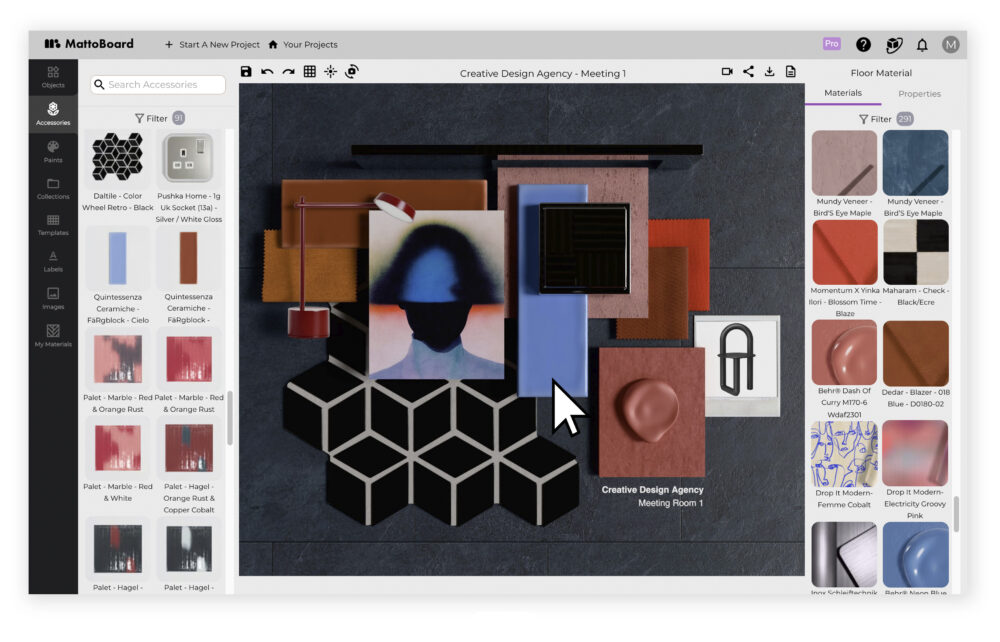
Guy Ailion: At Mattoboard, we’re simulating material aesthetics in 3D environments—how light hits a silk vs. a suede, how a terrazzo feels beside brushed metal. This is the ‘look & feel’ industry, compositions of material aesthetics is how designers create emotion, mood, and style. It’s through their ingenuity and taste for composition, not necessarily because of one material alone. We don’t simulate material physics at all. That is a different value and client. Structural integrity is more concerning for engineering spans than how the wall plaster feels when you run your hand on it, or how a light scollop engorges the patina of the wood.
We do, however, parse technical information and data from performance spec sheets attached to certain materials, so we can better understand if their performance criteria match the desired spec for the Interior Designer. We link our curation decision to fabrication data, durability, cost, fire ratings, and even carbon.
The Next Frontier: Context-Aware Design
ArchiExpo e-Magazine: Where do you see the next breakthrough for AI in design—context-aware systems that understand spatial relationships, cultural cues, or even client psychology? Is Mattoboard exploring that territory?
Guy Ailion: Context-awareness is the frontier. Not just what materials work together—but what works for this space, this story, this client—their budget, location, requirements.
We’re moving toward systems that understand layout, spatial flow, light, culture, and even personality. Not just “suggest a chair,” but “suggest the right anchor piece for a sociable living room in Mexico City, for a family that entertains every Friday.”
We’re building to prepare for that at Mattoboard. We’re layering emotion, region, culture, and purpose into every design stream. Because context isn’t extra—it’s everything. The foundational models are just not there yet; memory is still limited to 10k words, and that can fill up very quickly. Today, there is no point uploading multiple 10k-word documents to create a greater context window; the LLMs will ignore it. The next wave of design AI won’t just know ‘what’—it will know the rationale with the ‘why’.
ArchiExpo e-Magazine: If we fast-forward five years, what does the “AI-native design studio” look like to you? How will workflows, roles, and even the definition of a designer evolve as these tools mature?
Guy Ailion: Designers will sketch with AI the way musicians jam with instruments—fluidly, intuitively, without friction. It’s faster, looser, and more experimental. But it’s important to realise this will not be only for fictional pretty images or visualisations or storytelling, it will also be embedded into the administrative and technical art of delivery, procurement, strategy, and execution—even manufacturing and coordination will feel this way. We will conduct swarms of AI assistants, co-pilots, and agents to perform, while we choreograph and think more deeply. But more than that: your AI will know your style, your patterns, your principles. It will collaborate.
Those who play in this field will compete on their ability to ideate, interpret, and have taste for finding meaning. That is where value will be won and lost. Your taste to find meaning for others. Because meaning will always be valuable. The studio becomes a hive—part human, part machine. And the role of the designer? Not diminished. Elevated. You become the conductor. You decide the tempo, the mood, the shape of the story. In the AI-native studio, creativity moves at the speed of taste. And the designer becomes the editor-in-chief of possibility and the director CEO of finding meaning.