


The Cypriot-born designer blends precision, intuition, and timeless simplicity to redefine contemporary lighting and design.
Cypriot-born, London-based designer Michael Anastassiades has spent three decades redefining the language of contemporary lighting by merging engineering discipline with poetic restraint. Trained first as a civil engineer before turning to industrial design, he has built a body of work that pursues radical simplicity—stripping away visible technology and unnecessary complication to create lighting that feels effortless, familiar, and timeless. His approach treats technology as a discreet enabler rather than a visual statement, ensuring longevity, adaptability, and a sense of quiet clarity in each piece.
Beyond lighting—the field that first established his international reputation—Anastassiades moves fluidly across furniture, objects, jewelry, and spatial interventions, maintaining a consistent sensitivity to materials and craft. Among his latest creations in 2025 are the After chair for Fritz Hansen, the Halesia table lamp for Alessi, the Klotski for Tacchini and the Splash collection of rings for Shihara. A new lighting piece called Linked, done in partnership with Flos, should be launched in April 2026.
His practice balances industrial precision with artisanal techniques, resulting in work that is both technically rigorous and emotionally resonant. With major collaborations, significant institutional recognition, and a growing role in design education, Michael Anastassiades Studio stands as one of the most influential voices shaping the future of contemporary design.


Simplicity, Technology, and the Role of Digital Tools
If Michael Anastassiades’ aesthetic philosophy could be summarized in one sentence, it would probably be the work and discipline that eliminate complexity and aim for lightness and an effortless effect. His background as an engineer and his practical way of thinking certainly contribute to this, as he breaks down complexities whose relevance he believes designers should constantly question.
These principles also guide the way with which he blends highly technical components with the simple, clean design of his lighting items. For Anastassiades, technology’s purpose is to make things easier and not more complex. It shouldn’t be overwhelming to handle or figure out, and it doesn’t necessarily need to be visible. Additionally, using technology solely to impress or as a final goal contradicts the timelessness he seeks in his work.
“Technology is so fast-changing that it can rapidly become dated. If the light source becomes a protagonist in a fixture, then, once that particular light bulb ceases to exist, the design becomes dated—and that is not design for me,” Anastassiades told ArchiExpo e-Magazine.
Hence the importance of keeping technology as a tool rather than the main feature of a lighting item—also because of long-term functionality, as integrated lighting technology means that no repairs can be made unless the whole fixture is sent back to the factory.
“That is why we try to provide solutions where a bulb can be screwed into the fitting. Because a bulb, even if it changes in terms of its technology (LED, the past’s incandescent lights, compact fluorescent, or even halogen), that doesn’t really matter, because the screw fitting will always be the same,” he says.
Many changes have taken place in lighting technology during the past 15 years. The complexity of light bulbs grew considerably, with lights becoming both more efficient and intelligent. But Anastassiades believes that even connected, internet of things (IoT) lighting is just like any other technology.
“I believe in treating these resources as something that serves a purpose. One should make an effort to think of them not as limiting, but as a tool that allows you to expand,” he explains.
When it comes to digital tools used for simulation or prototyping, at Michael Anastassiades Studio these are only employed at the very end of the creative process—and never to generate ideas. From sketches to prototyping, everything in their production is done by hand in the first stages. Then come paper models and real mock-ups, and only after that does the studio use digital tools.


Importance of Materials and Artisanal Work
Anastassiades’ practice contemplates both industrial production and artisan techniques, which results in a nuanced balance between control and intuition. A clear example of that are the Cygnet Lights, which were presented at Salone del Mobile Milano 2025 in April and are being commercially launched now. Made from Japanese washi paper, they consist of two equilateral paper triangles illuminated by a hidden LED light source and are informed by Anastassiades’ childhood memories of kite flying.
“I think the hand, the craft element, is something that adds value to a product and makes it more approachable and human. It also brings individuality,” he believes.
Another example of Anastassiades’ craftsmanship can be seen in his Cheerfully Optimistic About the Future, a 2021 project shown at ICA Milano that featured lighting objects made of bamboo precisely held together with tied strings and inspired by 19th-century artifacts. The exhibition resulted in the TA-KE range, where elegantly crafted bamboo poles are set on a metal base, forming a structure that holds a linear bulb. The bulb is suspended equidistant from the poles by a series of wire springs that wrap neatly around them.
The way Anastassiades works with materials also strongly connects to his search for craftsmanship. Among the materials used by him are polished brass, satin brass, polished nickel, satin nickel, black patinated brass, hand-patinated brass, anodized aluminum, chrome-plated aluminum, earthen red powder coat, petrol blue powder coat, and white porcelain. The list is wide—but every material is treated with respect, reverence, and the intention to preserve its inherent qualities. The finishes are always natural, and no lacquer is used. Oxidation is seen not as damage but as a kind of maturation, a graceful patina that enriches an object’s character over time.
“There is beauty in every material, but the choices are never random. Brass, for example, has naturally warm colors, so the reflection you get is warm and very different from something reflecting on aluminum or nickel. Light technology, especially LED, requires a heat sink [a component designed to dissipate heat from a device] usually made of aluminum. After the choices are made come the decisions around treatment or finishing: should we make light be absorbed into the surface or get completely reflected from the surface? Each way leads to two very different outcomes,” he describes.

The Tube Chandelier: a Starting Point to an Established Legacy
“Lighting was my first design opportunity and my brand’s first goal. I decided to focus on it not because I was a specialist in the field, but because I felt I had more ideas to share when it came to lighting,” Anastassiades says.
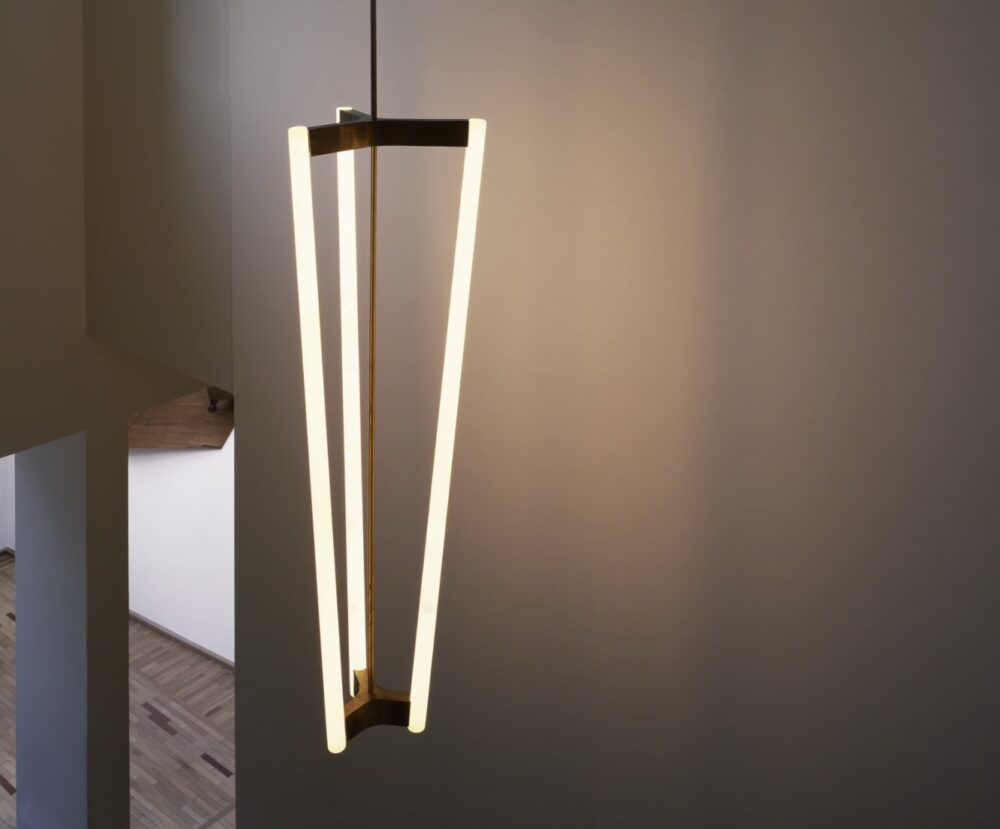
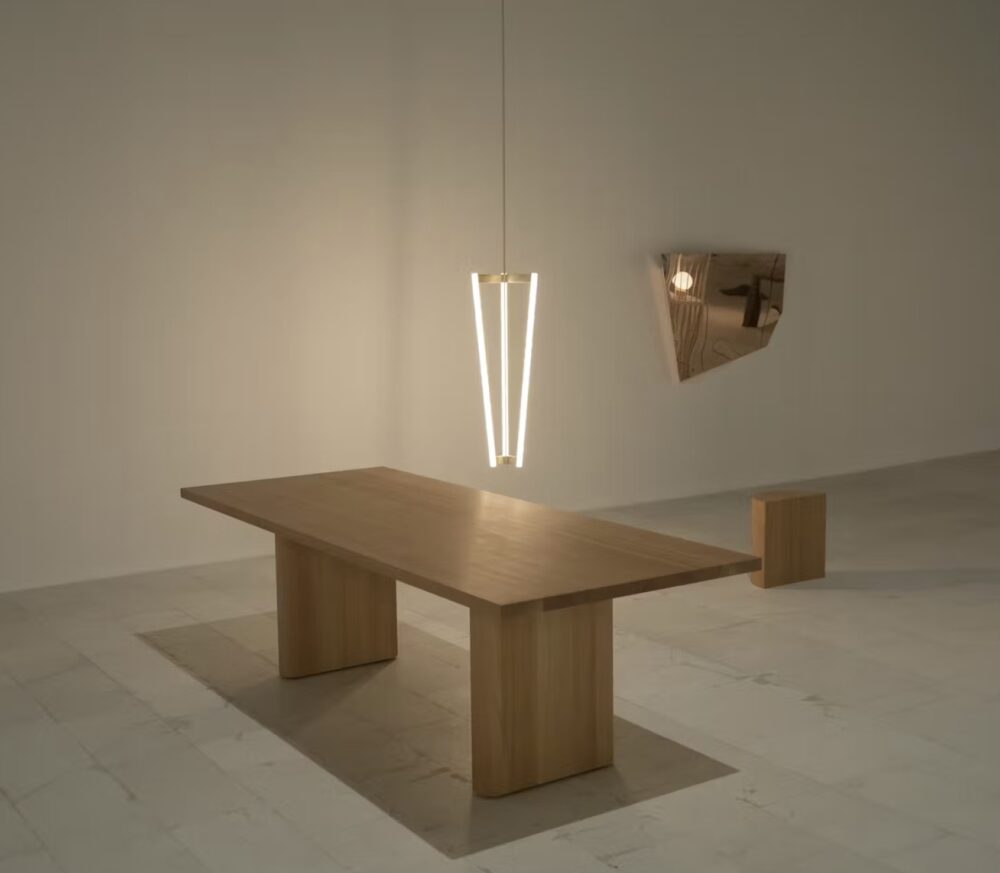
The iconic Tube Chandelier was the brand’s first light fixture and industrially produced piece. The Mobile series is another highlight in his timeline. The Mobile Chandeliers are finely balanced structures with both curved and straight elements composed in perfect equilibrium.
“They redefined lighting by showing that light could be moved around in a mobile structure. This didn’t exist before that,” he says.
Designed according to the principles of a traditional mobile, each piece brings together linear tubes, geometric light sources, reflective elements, and carefully calibrated counterweights. They rotate gently and freely, producing a constantly shifting lighting arrangement that adapts uniquely to the space around them. Each Mobile Chandelier is custom assembled to achieve balance among its roughly 200 hand-crafted, patinated-brass components. Because the weight of the mouth-blown opaline glass varies, every chandelier differs in its dimensions and overall compositional balance, making each piece entirely unique.
He doesn’t find the “switching” from lighting to other kinds of design challenging. He believes designers can apply their ideas to any scale, material, or discipline. It is no surprise that the striking simplicity of his lighting pieces is also evident in his other items.