



Dubai is pushing forward with cutting-edge construction technologies—from fibre-reinforced concrete systems to large-format 3D printing—while regulators and industry leaders work to balance innovation with safety and long-term performance.
In a hurry? Here are the key points:
- Dubai is rapidly adopting next-generation technologies such as Apis Cor’s 3D-printing systems, Bekaert’s Dramix steel fibres, and GCP’s STRUX macro-fibres to modernize construction.
- These solutions promise cleaner sites, faster project delivery, reduced rebar use, and lower embodied carbon across major developments.
- Regulators emphasize that innovation must advance alongside rigorous safety, testing, and performance verification to ensure resilient, code-compliant structures.
Dubai has rapidly positioned itself as one of the world’s most ambitious testbeds for next-generation construction technologies, advancing a built-environment agenda that prioritizes speed, safety, and sustainability at scale. Over the past two years—particularly through 2024 and 2025—the emirate has accelerated the adoption of innovations such as large-format 3D concrete printing by robotics companies like Apis Cor, advanced fibre-reinforced systems from suppliers including Bekaert with its Dramix 4D and GCP Applied Technologies’ STRUX macro-fibres, as well as self-healing admixtures and optimized digital mix-design platforms. These technologies are no longer theoretical experiments; they are being promoted for deployment across industrial flooring, infrastructure tunnels, precast modules, and residential construction. Early use cases promise cleaner construction sites, faster delivery, reduced reliance on conventional reinforcement, and lower embodied carbon in structural elements.
Yet progress requires precision. As Ihab Bassiouni of Dubai Municipality noted during a panel at The Big 5:
“It’s very delicate… how to balance between both. It’s not easy,” referring to the challenge of encouraging innovation while ensuring public safety, regulatory compliance, and long-term performance.
The region’s authorities now face the task of validating emerging systems—whether steel-fiber-reinforced concrete used to replace part of the rebar in foundations, synthetic macrofibres introduced to streamline megaproject flooring, or 3D-printed structural walls produced in hours rather than days. The Middle East’s construction boom makes this balancing act especially urgent: as the sector embraces transformative technologies, regulators must ensure that safety and durability evolve just as quickly.
The Role of Standards in Enabling Safe Innovation
The session was moderated by Mohamed Amer, Managing Director – MENA, International Code Council (ICC), who opened the discussion by emphasizing the role of standards and performance-based design in enabling safe innovation. Amer highlighted the ICC’s responsibility in codes, testing, and certification, noting ongoing collaborations with ACI on low-carbon cement criteria and emerging materials.
Bassiouni emphasized that Dubai’s building code already supports innovation through performance-based provisions, allowing new technologies to be approved even when not explicitly covered in prescriptive rules.
“We give the opportunity to material producers… to create new products and get them used in concrete as an alternative to the prescribed fixed designs,” he added.
Exemplary projects: Dubai’s innovation drive is already visible on the ground — from the Dubai Municipality office printed on-site by Apis Cor in 2019, which showcased rapid, large-format 3D printing for municipal buildings; to Expo City Dubai’s 2024 deployment of Bekaert’s Dramix® 4D fibres in large floor-on-ground areas to reduce rebar, improve crack control and lower embodied carbon; and while GCP Applied Technologies’ STRUX® macro-fibres are actively marketed and supplied into the UAE market and used internationally in high-performance slabs, a publicly documented, named UAE project citing STRUX in press materials is not available at this time and we recommend vendor confirmation for a UAE-specific case.
Understanding the BSA: Building System Approval Process
Dubai Municipality, one of the main governing bodies over the city of Dubai, operates the Building System Approval (BSA) process, which enables comprehensive testing and evaluation of innovative systems through documented research, third-party assessments, and pilot projects. He noted that the authority is introducing an “in-principle approval” stage—a pre-evaluation mechanism allowing system owners to obtain early technical feedback before investing in full-scale pilots or manufacturing facilities.
However, Bassiouni underscored that regulation alone is not enough. The municipality is actively looking to incorporate a new innovative platform designed to bring regulators, academia, consultants, manufacturers, and the public together.
“Everyone will be part of the whole process,” he said, explaining that this collaborative environment, combined with industry education and sandbox testing spaces, will speed up adoption and reduce uncertainty.
Many engineers, he observed:
“are not aware of new technologies because they are busy with their day-to-day jobs,” making education a crucial priority.
ACI’s Contribution to Concrete Knowledge and Standards
Also on the panel was Ahmad Mhanna, Director, Middle East / North Africa Region at ACI, who described how the organization’s century-long history is rooted in industry expertise and continuous evolution.
“We heavily depend on our members… to develop these standards,” Mhanna said, noting that ACI now maintains more than “35,000 pages of concrete knowledge” spanning material science, structural design, construction, repair, resilience, and sustainability.
He highlighted ACI 318—the world’s leading structural concrete design code—as an example of flexibility and innovation-readiness. When a material or system is not covered explicitly, Mhanna explained:
“It allows the use of that material or system in collaboration with the building official and the system owner.”
This pathway, often used alongside ICC acceptance criteria, allows innovations to enter the market without compromising safety.
Shifting Toward Resilience and Whole-Life Performance
Mhanna also addressed ACI’s strategic shift toward resilience and whole-life performance. A resilient structure, he noted, is one that can recover its functionality after a disruptive event—an increasingly important consideration in modern codes. He stressed that long-term operational savings and durability benefits often outweigh higher upfront material costs.
But the biggest barrier, Mhanna argued, is not technology but perception.
“Many engineers don’t have enough background… they deal with it as a new material,” he said, pointing out that solutions such as steel fiber-reinforced concrete have existed for more than 50 years and are globally validated across tunnels, slabs, precast elements, and industrial projects.
Adding the manufacturer’s perspective, Ahmad Mandalawi, Regional Structural and Specification Engineer, Bekaert, reinforced the need for industry-wide education and early involvement of system owners in design. He explained that engineers often hesitate to approve fiber-reinforced systems simply because they fall outside their traditional training or because codes do not yet feature abundant examples. Owners, he added, tend to compare materials “like-for-like” on price rather than examining lifecycle value. He urged stakeholders to focus on “the total cost of ownership,” including reduced construction timelines, labor savings, corrosion mitigation, and long-term durability.
Fiber-Reinforced Concrete in Dubai’s Landmark Projects
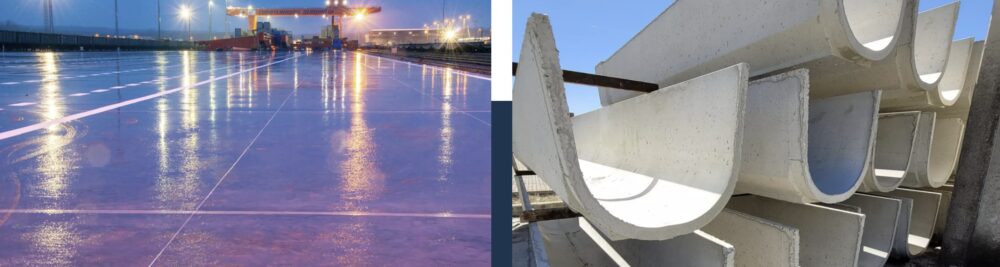
Mandalawi said that Dubai Metro Blue Line extension, where steel fiber reinforcement was used in segmental tunnel linings, has seen faster installation and substantial reductions in embodied carbon. He also cited the Expo City townhouses, where switching from traditional rebar to fully fiber-reinforced slabs resulted in up to 30% lower CO₂ emissions, 50% fewer steel bars, and 15–20% total cost savings, all without compromising structural performance.
All panelists have agreed that innovation does not have to come at the expense of safety. With performance-based codes, rigorous testing frameworks, and stronger collaboration between regulators, standards bodies, consultants, and manufacturers, the Middle East is well-positioned to lead a new era of sustainable, efficient, and resilient construction.