

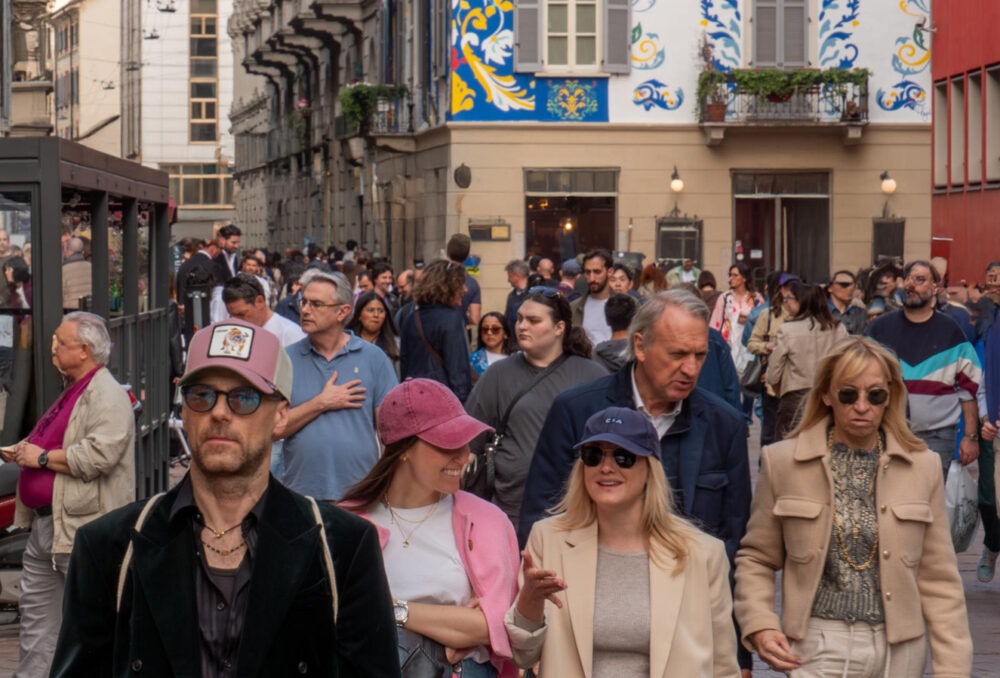

“THINKING BETTER, Look back to shape the future” could mean anything or nothing, depending on who’s interpreting it. But walking through the Tortona Design District during Fuorisalone, a few projects made this year’s slogan feel earned. Here are three.
Mastering Water: Flow, Form, Function
At Via Tortona 31, inside Opificio 31, Swiss company Geberit is opening a permanent space: an 800-square-metre Experience Center dedicated to bathroom technology. The timing is strategic: Design Week brings the crowds, but the space will stay open year-round.
If you don’t know Geberit: they’re the European leader in sanitary products, founded in 1874 in Rapperswil-Jona, Switzerland. They celebrated 150 years in 2024, employ about 11,000 people across 50 countries, and reported 3.2 billion Swiss francs in sales last year. Italy is their third-largest market.
For the opening, they’ve commissioned Flow. Form. Function., an installation by Swiss studio atelier oï. Atelier oï (founded 1991, based in La Neuveville) has worked with Louis Vuitton, Artemide, B&B Italia, Bulgari and Issey Miyake. They won the Kenneth Hudson Award at the European Museum of the Year in 2015, plus various Red Dot and iF prizes. For Geberit, they’ve created something that feels both technical and poetic: an ode to plumbing as choreography.
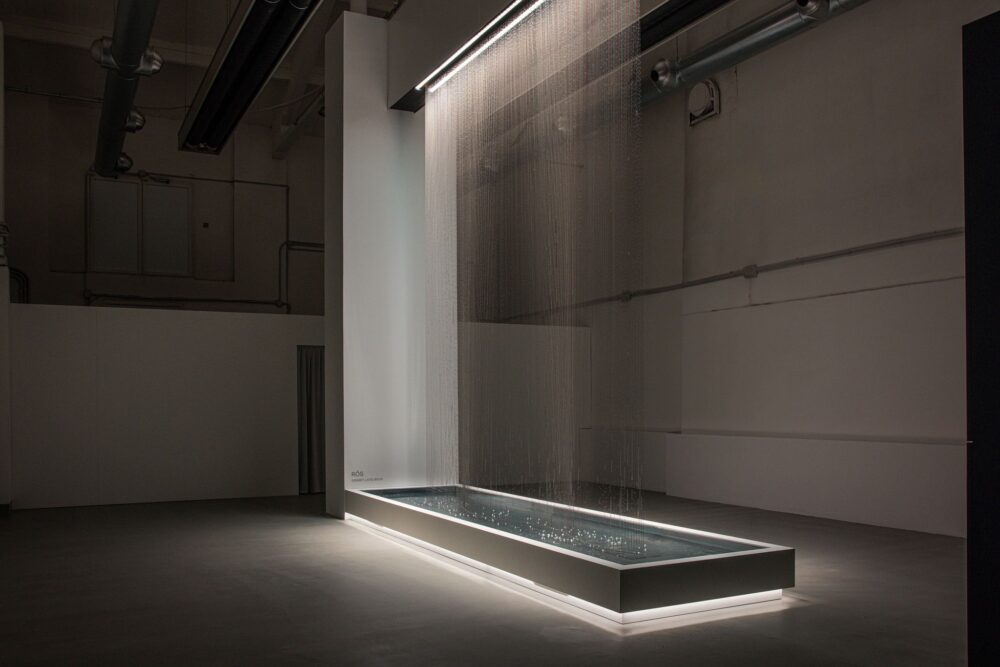
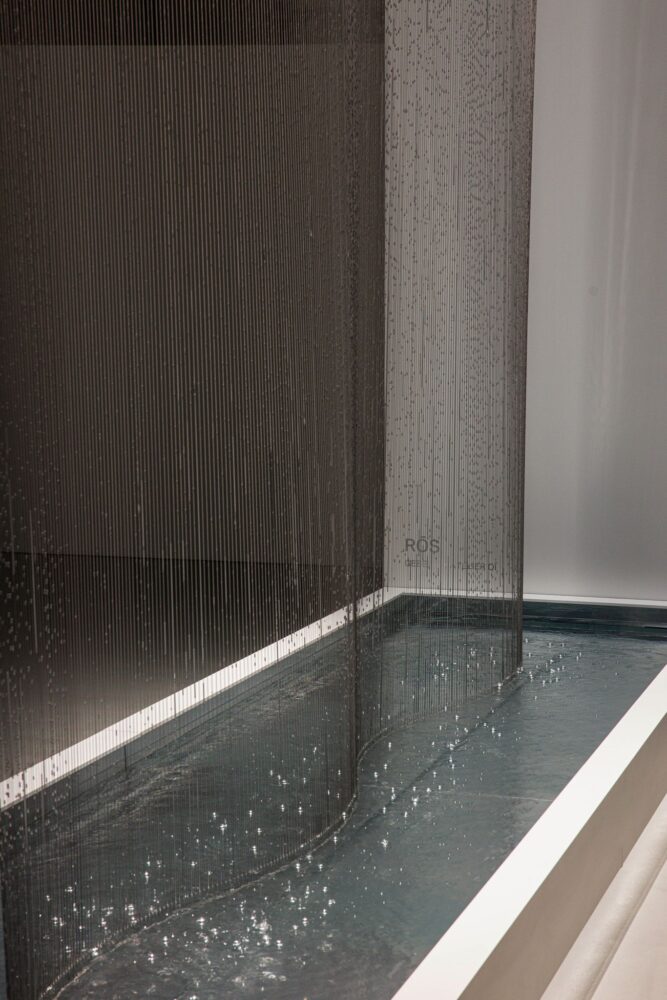
The centrepiece is RŌS: hundreds of fine stainless steel springs arranged in a flowing curtain. Water droplets move through them, tracing paths that shows the flow that usually happens inside pipes and walls, away from the eye.
“With RŌS, we wanted to give visible shape to what normally remains hidden: the movement of water, its precision, and its ability to create a connection between technique and emotion,” Timo Heiniger, Associate Interior Designer at atelier oï, said in a statement. “For us, that flow becomes a design gesture, an experience capable of expressing lightness, function, and harmony all at once.”
The Experience Center itself — designed by Ippolito Fleitz Group, with strategic input from POLI.design at Politecnico di Milano — is organized around the concept “Mastering Water.” There’s a tower with live hydraulic demonstrations, a tech area with holographic content, nine configurable bathroom setups, and a bar. It’s part showroom, part education hub, part event space. Architects, designers, installers, clients: everyone’s invited.
Design Process Documentation with Hyundai
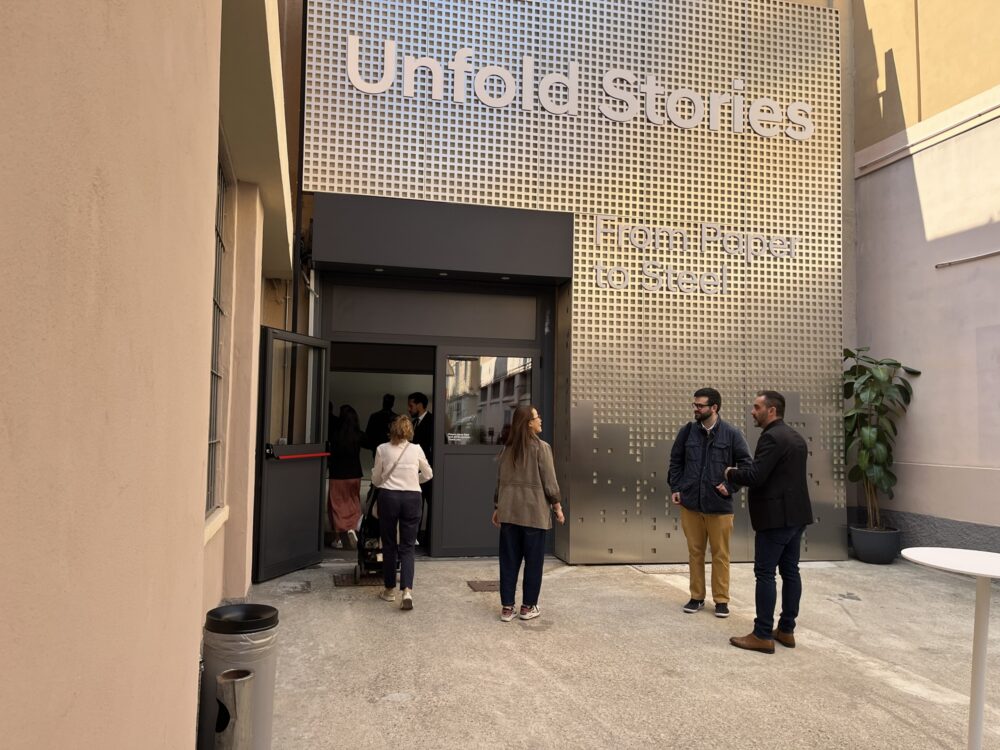
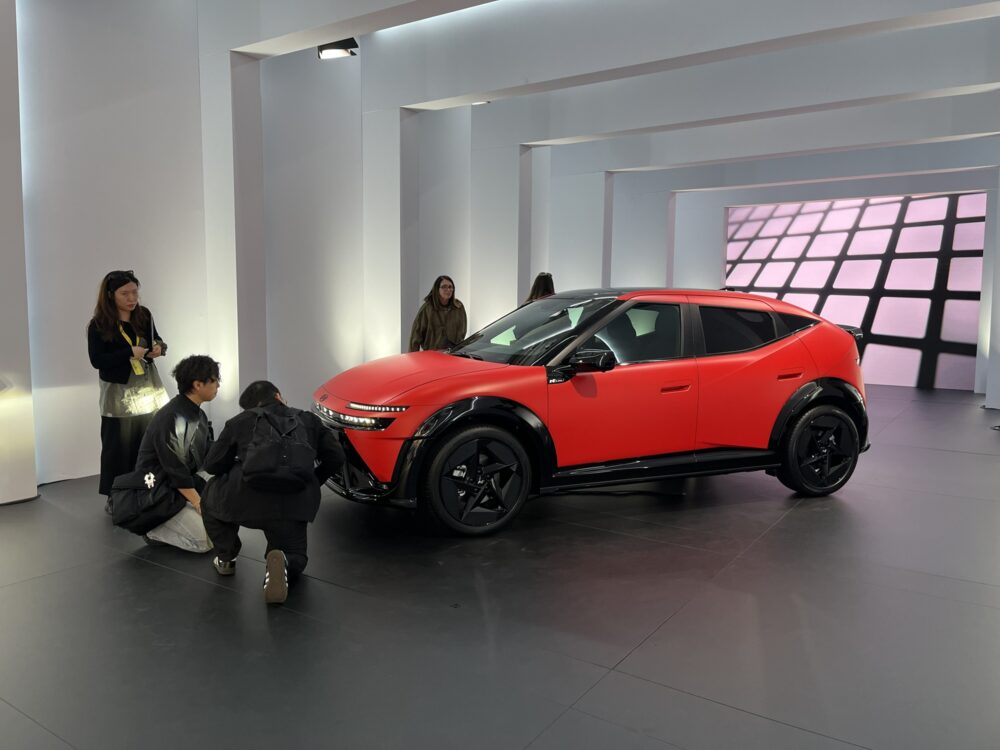
At Torneria Tortona, Hyundai is doing something unexpected: using Milan Design Week to debut a car. IONIQ 3, the Korean automaker’s new compact electric vehicle, gets its world premiere here: not at a motor show, but surrounded by sketches, material samples and design process documentation.
The interactive installation is called Unfold Stories – From Paper to Steel, and it’s exactly that: a walkthrough of how Hyundai moves from initial sketch to finished product. For anyone interested in automotive design, it’s a rare look behind the curtain, and an opportunity to reflect on what goes into the process.
Some context helps. Hyundai, founded in 1967, has transformed its design reputation over the past decade. The person responsible is SangYup Lee, Executive Vice President and Head of Hyundai and Genesis Global Design. Lee trained as a sculptor at Hongik University in Seoul before studying transportation design at ArtCenter in Pasadena. He spent years at GM — where he designed the iconic fifth-generation Camaro (yes, the one you saw in Transformers) — then moved to Bentley, where he shaped the Continental GT and Bentayga. In 2016, he joined Hyundai. In 2023, he was named World Car Person of the Year. Working with him is Luc Donckerwolke, Hyundai’s President and Chief Design Officer: a Peruvian-Belgian designer who previously gave Lamborghini the Murciélago and Gallardo. He won the same award in 2022.
The Milan presentation includes workshops led by the design team. You can ask questions, handle materials, and understand how “Sensuous Sportiness” (Hyundai’s design language) actually gets built. The IONIQ 3 itself awaits at the end of the route. It’s compact, electric, and built on the E-GMP 400V platform, arriving in Europe later this year as part of Hyundai’s commitment to full electrification by 2027. With over 600,000 vehicles sold in Europe in 2025 and a 4.2% market share, the Korean automaker clearly has momentum; choosing Milan Design Week for a world premiere suggests they want to be seen as a design company, not just a car company.
Femininity in Architecture: A Public Space that Feels like an Embrace
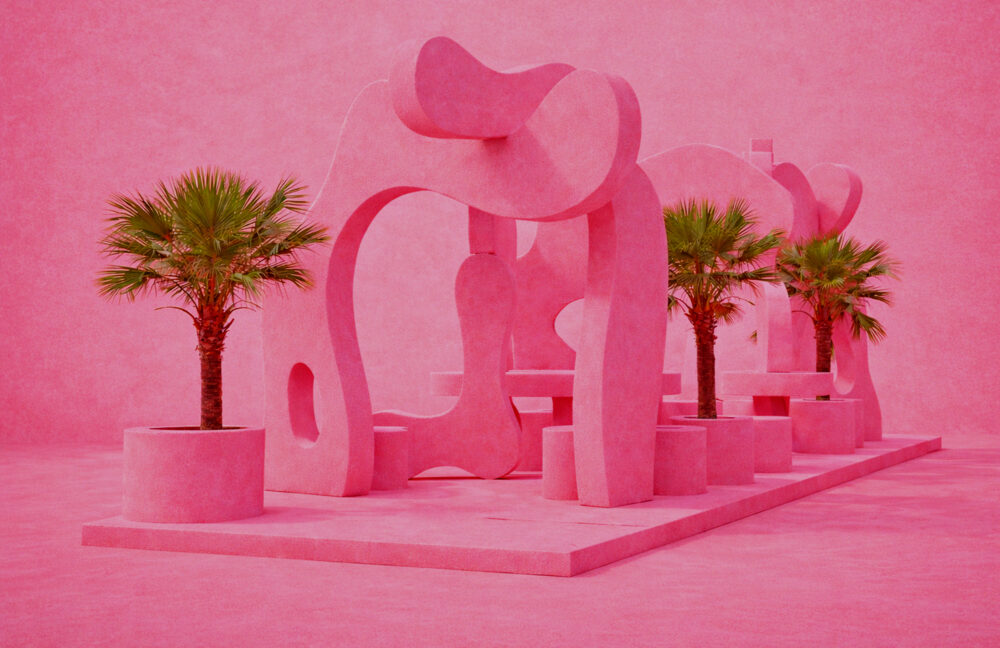
On the other side of the road, in Via Tortona 25, Italian designer Sara Ricciardi created a space that sits between a garden and a body. Corpografia – Paesaggio di Donna is an eye-catching object made of soft, curving forms, painted in an aggressive pink. The kind of pink Elsa Schiaparelli made famous in the 1930s, the kind that refuses to be ignored.
Ricciardi, who grew up in Benevento and trained in Milan, Istanbul and New York, has a thing for narrative. She graduated from NABA in product design, founded her studio in 2015, and later opened Pataspazio, a Milan atelier dedicated to what she calls “expressive arts”. She’s also a big deal: Triennale included her among the Women of Contemporary Italian Design; Wallpaper named her a Next Designer Generation finalist in 2018; she teaches at NABA and Domus Academy. Her projects tend to start with a concept — usually something about how people relate to space and each other — and work backward to form.
This time around, she’s thinking about femininity not as decoration, but as architecture. The shapes suggest limbs and torsos. You can sit on them, lean against them, and gather around them. Plants weave through the installation, people sit down to chat with friends, have a snack, lay in the sun. The effect is intimate, almost confidential: a public space that feels like an embrace. In a statement, the designer herself described it as both “threshold and passage”, with bodily shapes becoming “a hospitable architecture, a public gesture, a shared space.”
These three projects are definitely different, but they share a certain ambition. Ricciardi turns the body into architecture. Hyundai turns car design into public conversation. Geberit turns water flow into art. That’s Tortona at its best: companies and designers using the week to show, not just what they make, but how they think.