


As King Swings launches four new collections this winter, the Amish-rooted manufacturer reveals how customization, material innovation, and outdoor-living integration are reshaping the future of backyard design.
New Releases by King Swings
- February 2: The Forest Loft Launch
- February 16: The Atlantic Launch
- February 23: The Frontier Launch
- March 2: The Indoor/Outdoor Kitchen
In February and March 2026, Pennsylvania-based King Swings will roll out four new collections— the Forest Loft, Atlantic, Frontier, and an Indoor/Outdoor Play Kitchen — expanding its portfolio beyond traditional backyard play structures into fully integrated outdoor lifestyle design. Founded in the 1980s by an Amish craftsman and now led by second-generation owner Elmer King, the family-owned company has become a national leader in premium, customizable swing sets and playhouses. With explosive post-pandemic growth, an emphasis on low-maintenance materials, and a design-forward aesthetic aligned with contemporary residential architecture, King Swings is positioning itself at the intersection of craftsmanship, customization, and outdoor living.
In a recent interview, Janet Malin, Chief Marketing Officer at King Swings, discussed how the brand is responding to emerging design and architecture trends from bespoke outdoor installations to lifecycle thinking, while launching products that treat play structures as architectural elements rather than backyard afterthoughts.
Customization as Core Design Strategy
Customization is no longer an optional upgrade in residential design. It is a baseline expectation. At King Swings, it is the foundation of their manufacturing model.
“Everything literally is made to order,” Janet explained. “We have about 30 standard models, but pretty much everyone does some sort of customization or tweak based on their family’s needs, their backyard, and the ages of their children.”
Rather than producing fixed SKUs, King Swings treats each project as a site-specific design problem. Their swing sets and playhouses are adapted to property constraints, landscape layouts, and architectural contexts, allowing designers and homeowners alike to treat play structures as permanent backyard installations rather than disposable consumer products. Janet emphasized that flexibility in configuration is as critical as visual appeal:
“Customization gives people control over how it actually lives in their yard.”
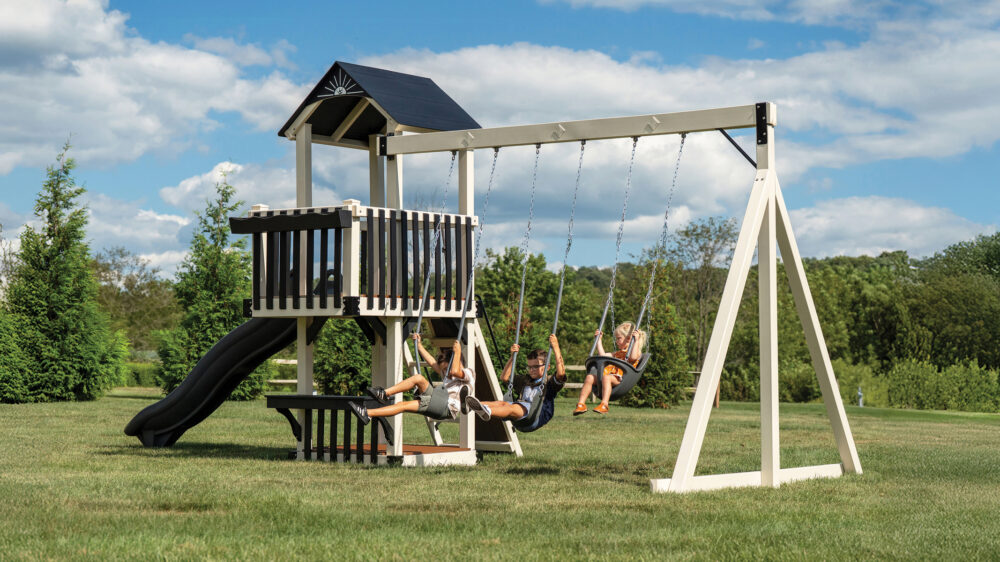
This philosophy directly informed the February 2 launch of the Forest Loft, a compact structure designed for smaller footprints without sacrificing longevity.
“We wanted a smaller set that grows with kids,” Janet said. “So the swing beam is higher, the deck is raised, and the play value lasts longer — even though the footprint stays tight.”
For design professionals, this approach echoes broader architectural shifts toward modularity, adaptability, and spatial efficiency. King Swings’ made-to-order model positions play structures not as accessories but as integral components of residential site planning. It’s a shift that mirrors how outdoor kitchens, pergolas, and studios have entered the architectural lexicon over the last decade.
Blending Play with Contemporary Outdoor Aesthetics
One of the strongest shifts in the outdoor products sector is aesthetic: play equipment is no longer expected to announce itself with bright plastics and visual noise. Instead, it must integrate seamlessly into curated landscapes and architectural environments. Janet noted that customers increasingly want their play structures to “disappear” into the overall backyard composition.
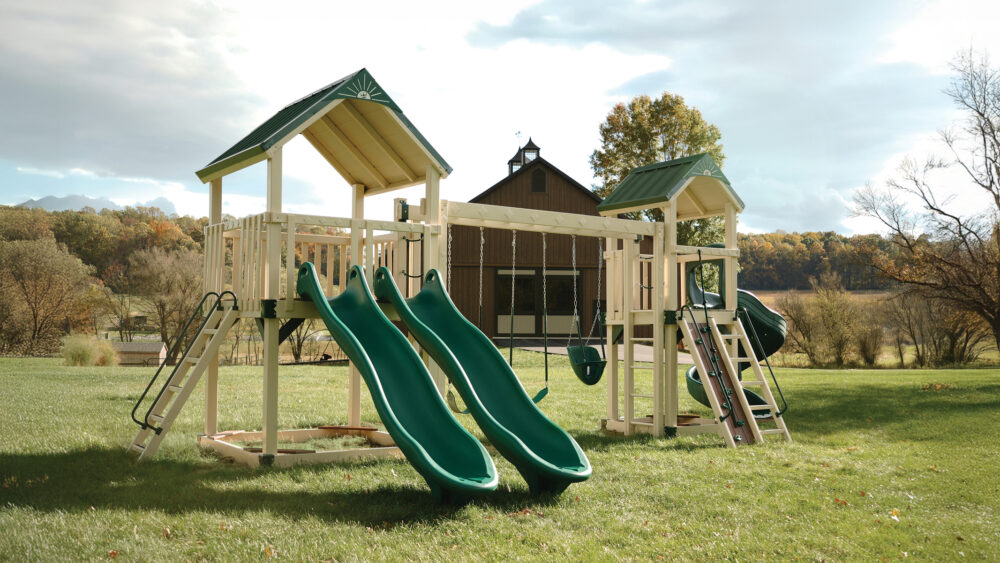
“What people want is for it to blend in with the rest of their home and their aesthetic,” she said. “Black, white, and gray combinations are very popular because they match modern exteriors and feel clean. Others want greens and ivories so it fades into the landscape.”
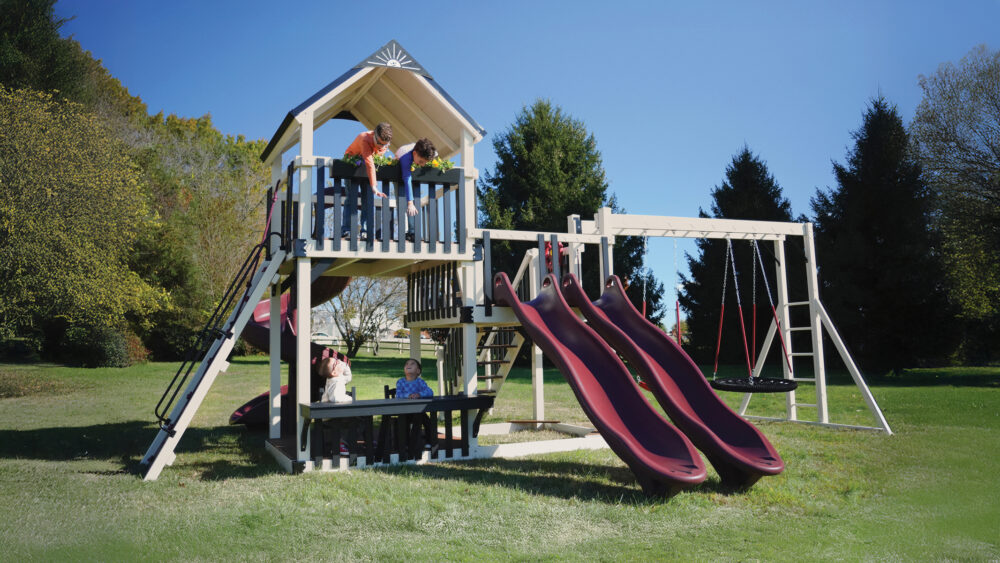
In response, King Swings introduced its Naturalist Series, pairing black vinyl structural elements with brown paneling that evokes wood tones. The goal, Janet said, is to avoid artificial-looking materials while preserving performance. This design philosophy is evident in the upcoming Atlantic and Frontier collections, launching February 16 and 23, respectively. Both emphasize architectural rooflines, layered decks, and neutral palettes that read more like contemporary backyard pavilions than traditional swing sets. The approach aligns with what landscape architects and residential designers are already seeing: outdoor amenities are now expected to harmonize visually with modern homes, not compete with them.
“Ultimately, yes, parents want this nice aesthetic and easy maintenance,” Janet said, “but it’s really about how the kids play, how they move through space and interact with the structure.”
The result is a design language that prioritizes both experiential flow and architectural coherence, reframing play as spatial engagement rather than equipment usage.
Durable Materials, Craftsmanship, and Manufacturing Transparency
Material innovation is another defining trend shaping the design and architecture industries, particularly in outdoor applications where longevity and maintenance drive specification decisions. King Swings transitioned fully from wood to vinyl-based structures five to six years ago, responding to durability concerns and consumer expectations.
“The market really started moving toward low-maintenance products that would last longer — no rotting, no splinters, no insects,” Janet said. “Now it’s become the dominant material for this type of product, and it’s all we sell.”
Yet despite modern materials, the manufacturing process remains deeply rooted in Amish craftsmanship. Every structure is built to order in Pennsylvania using hand tools, with limited automation.
“Nothing gets built until we have an approved design and order,” Janet explained. “There’s nothing sitting around. It’s made in line with when that truck is going out.”
King Swings sources roughly 98 percent of its materials domestically, including TREX composite decking, which Janet cited as both a functional and brand-signaling choice.
“People are drawn to TREX. When we say we use it, they’re like, ‘Oh, wow.’ That gives us credibility in terms of quality.”
The company has also vertically integrated certain components, including slide molds, to maintain quality control and reduce supply chain disruptions. For architects and designers, this model reflects broader industry priorities: transparency, domestic sourcing, material resilience, and lifecycle performance. These are no longer marketing differentiators. They are professional requirements.
“It’s amazing how much of it is still hands and tools,” Janet said. “That’s really it.”
Outdoor Living Integration and Lifecycle Thinking
Perhaps the most significant shift shaping King Swings’ product strategy is the transformation of the backyard into a fully programmed outdoor living environment. Pools, kitchens, cabanas, fire features, and wellness structures now coexist in residential landscapes, and play spaces are increasingly expected to belong in that ecosystem.
“We’re really into this idea of additional square footage outdoors,” Janet said. “You’ll see homes with a house, a pool, a cabana, a dock — and our swing set. It becomes part of the whole luxury outdoor experience.”
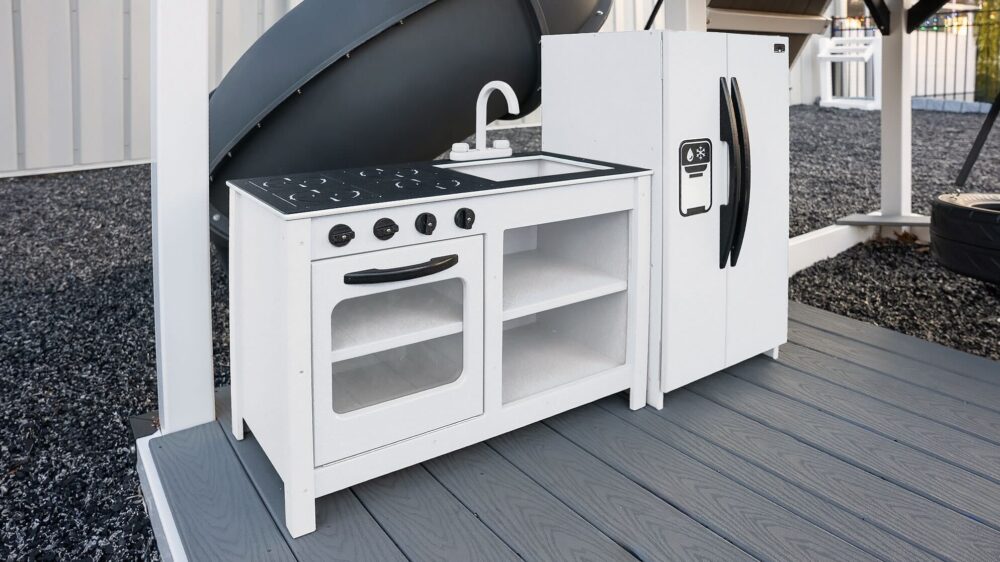
This thinking directly inspired the upcoming Indoor/Outdoor Play Kitchen, launching March 2. It’s the company’s first standalone accessory designed to function both inside playhouses and in open-air environments.
“Customers were already buying kitchens from other companies to put in their playhouses,” Janet explained. “So we said, we should be selling a kitchen that can be indoors or outdoors and still carry the same warranty.”
The piece reflects broader architectural trends toward flexible-use furnishings and blurred indoor-outdoor boundaries. But Janet also raised a less-discussed issue: product lifecycle responsibility. As King Swings’ structures are built for decades of use, the company is beginning to consider what happens when children outgrow them.
“In five or ten years, we’re going to need some sort of revolving program,” she said. “What do people do with these? How do we keep the lifecycle going instead of sending them to a landfill?”
This emerging concern aligns closely with architecture’s growing emphasis on circular design, adaptive reuse, and material stewardship. For King Swings, it marks the next frontier: designing not just for performance and beauty, but for responsible end-of-life strategies in large-scale outdoor products.