


From additive manufacturing to serviceable fixtures and U.S.-based production, LightArt’s Ryan Smith explains how lighting makers can meet sustainability demands while staying agile in a volatile market.
Best Practices for Designers & Architects
- Prioritize serviceability: Specify fixtures that allow drivers, LEDs, and components to be replaced — not discarded.
- Ask about manufacturing origin:U.S.-based production offers advantages in lead times, quality control, and supply chain resilience.
- Look beyond recycled content:True sustainability includes modularity, repairability, and reduced inventory through on-demand production.
- Embrace advanced manufacturing: Additive and digital fabrication enable customization, faster prototyping, and less material waste.
- Balance integration and expression: Combine invisible architectural lighting with sculptural fixtures that contribute emotionally to space.
The lighting industry is undergoing a profound shift. For decades, innovation meant better efficiency, lower wattage, and tighter optics. Today, those metrics are table stakes. Designers, architects, and manufacturers are now grappling with bigger questions: How do we design fixtures that last? How do we reduce material waste while improving performance? And how can American manufacturing stay competitive in a globalized supply chain?
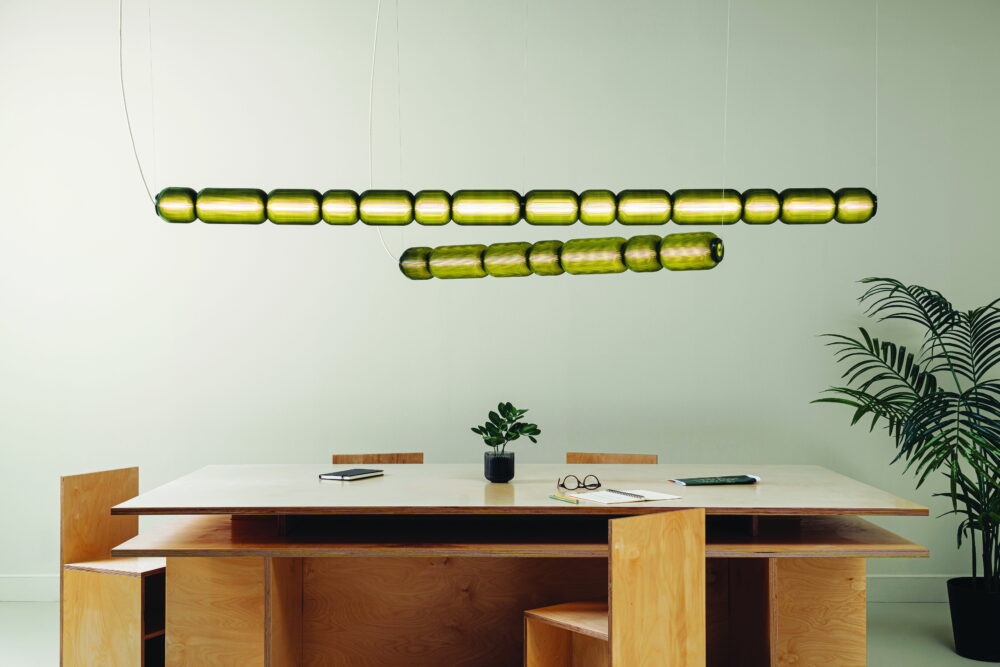
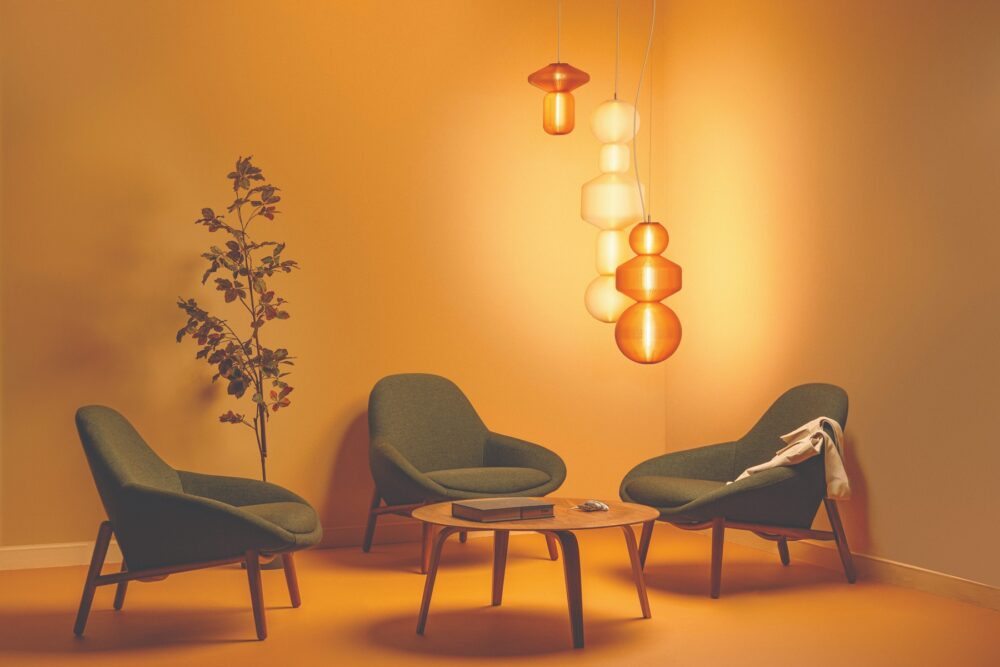
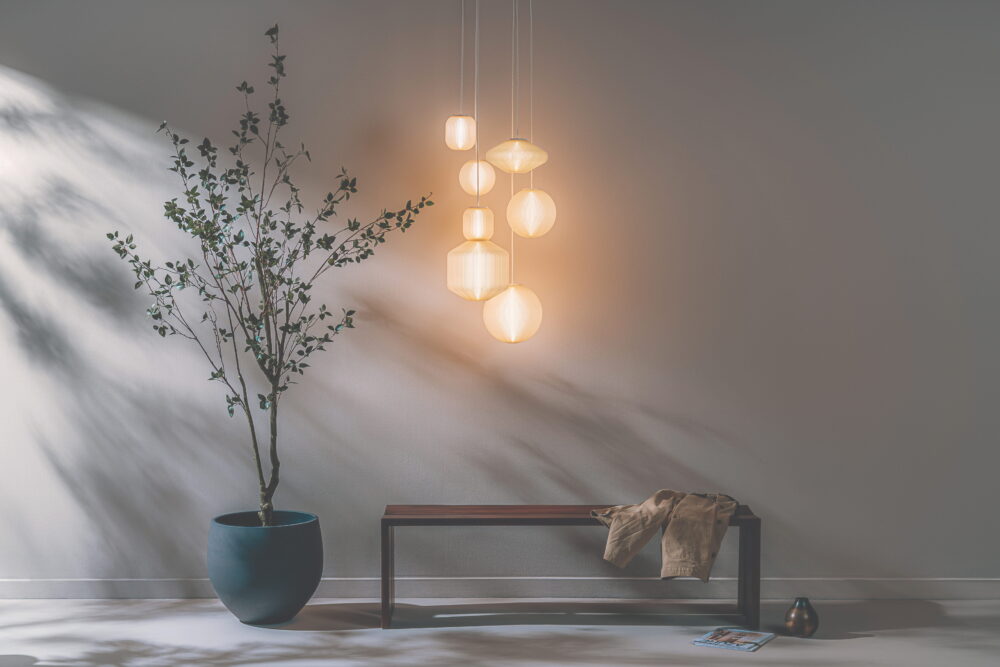
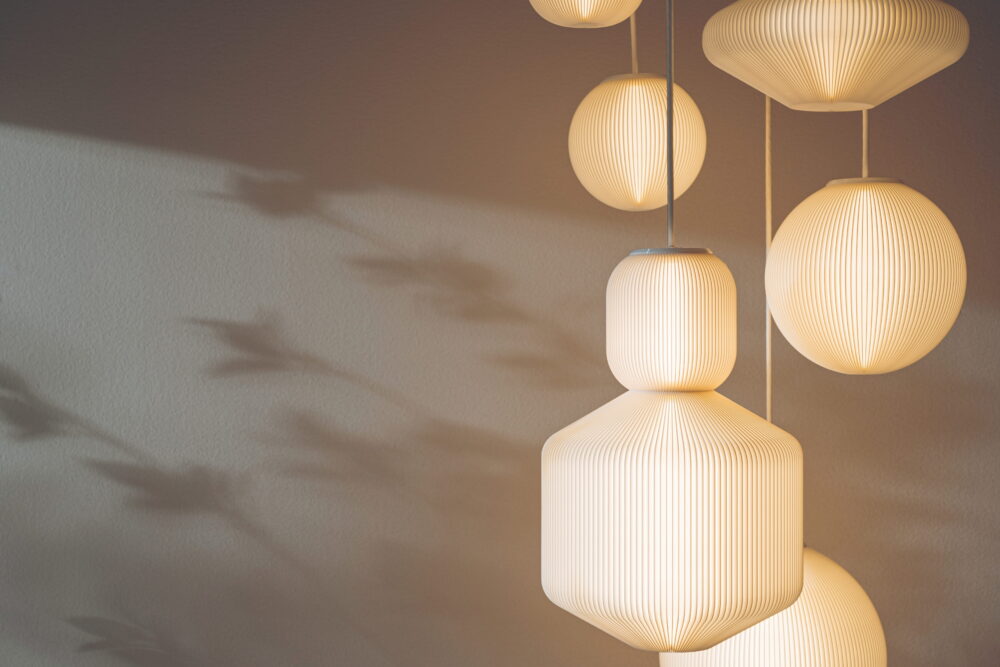
At LightArt, a lighting studio with manufacturing in Salt Lake City and Seattle, Chief Creative Officer Ryan Smith has been thinking about these questions for years. The company’s newest release, the Somari Collection — officially launched October 21, 2025 — uses additive manufacturing to reinterpret the softness of paper lanterns into sculptural, modular pendants that are customizable, serviceable, and made in the U.S.
“For us, it’s not just about what the shape looks like,” Smith says. “It’s about the entire story: We make things right here in the U.S. We can have short lead times, we can control quality, and we can rethink how fixtures are built from the inside out.”
In an era marked by sustainability pressure, labor shortages, and supply chain volatility, LightArt’s approach offers a revealing case study in how lighting manufacturing is evolving.
American Lighting Manufacturing in a Globalized Supply Chain
For decades, the lighting industry has leaned heavily on overseas manufacturing, particularly for metal fabrication, housings, and electronics. While this has kept prices competitive, it has also exposed manufacturers to extended lead times, geopolitical risk, tariffs, and sudden supplier disruptions. These challenges became especially visible over the past five years.
Smith describes how even domestic sourcing has become unpredictable.
“We lost an aluminum supplier a few years ago. They went to 50-week lead times,” he says. “That’s basically a year. We weren’t big enough for them, so we had to pivot fast.”
Rather than doubling down on overseas production, LightArt leaned further into U.S.-based manufacturing — not just assembly, but fabrication, finishing, and now digital production through extrusion-based additive manufacturing.
“We do so much of it here — sheet materials, lighting, crating, parts design,” Smith explains. “So if an ingredient changes, we can look at the landscape and say, ‘Okay, we control this. Let’s change how we do it.’ That flexibility is huge.”
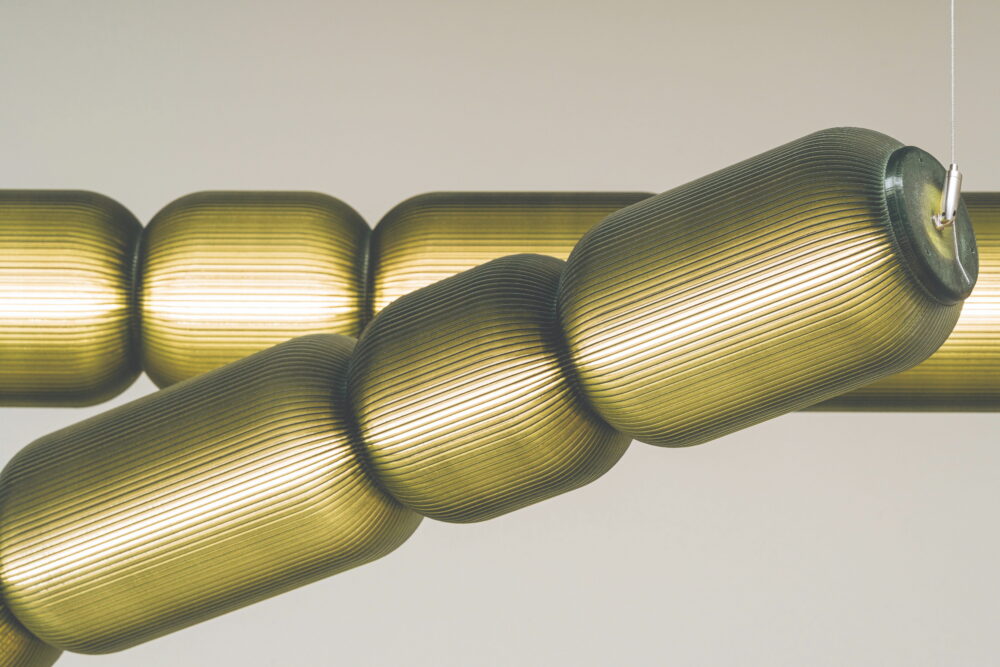
That flexibility became central to Somari’s development. Rather than relying on tooling or overseas molds, LightArt used in-house 3D printers to fabricate shells, connectors, and structural components. The result: shorter lead times, less inventory, and the ability to adapt designs rapidly.
“For us as a U.S. manufacturer, there are always cost constraints for labor, materials, and pricing pressures,” Smith says. “So the question became: how can we do this here, 100% in-house, and still hit a viable price point? Additive manufacturing unlocked that.”
For architects and designers, this has real-world implications: faster turnaround, easier customization, and products that are easier to service long-term, all while supporting domestic production.
Circular Design and Serviceability Are No Longer Optional
Sustainability has shifted from marketing narrative to market expectation. Specifiers increasingly demand transparency around material sourcing, embodied carbon, recyclability, and end-of-life strategy. But Smith argues that the biggest sustainability blind spot in lighting isn’t energy use. It’s disposability.
“Everyone jumped into LEDs over the last ten years, and so many fixtures were built in ways you can’t take apart,” he says. “When something fails, you can’t service it. You just throw it away. That’s a massive problem that hasn’t been fully reckoned with yet.”
At LightArt, serviceability is treated as a design principle. Fixtures are engineered so drivers, LEDs, and components can be replaced rather than scrapped. With Somari, this logic goes further: Components are printed on demand, reducing the need for excess inventory and enabling rapid part replacement.
“We wanted to design a system where we don’t have to stock pile parts,” Smith explains. “If something changes, we design it and print it overnight. That’s magical, and it’s also far more sustainable.”
The material strategy supports this approach. Somari uses PLA-based polymers, many of which can be bio-generated, and LightArt is working with U.S.-based filament suppliers to reduce transportation emissions while maintaining tight control over color systems and finishes.
“We’re sourcing U.S.-made filament now, and we’re even getting our own colors made for us,” Smith says. “That shortens the supply chain, reduces shipping impact, and keeps our material story aligned with our sustainability goals.”
LightArt also participates in transparency frameworks like Declare labels and Environmental Product Declarations (EPDs), providing architects with ingredient disclosures and environmental performance data, increasingly essential for meeting project certification requirements and client sustainability goals.
The deeper implication for the industry is clear: circularity isn’t just about recycled content. It’s about designing products that can be repaired, upgraded, and reconfigured, and manufacturing systems flexible enough to support that lifecycle.
Advanced Manufacturing Technology Meets Sculptural Design
Lighting design today sits at a crossroads. On one side is ultra-minimal architectural lighting — linear slots, concealed sources, and systems that disappear into the built environment. On the other is a resurgence of sculptural, expressive luminaires that act as architectural features in their own right.
Somari occupies an intentional middle ground. Inspired by Isamu Noguchi’s iconic paper lanterns, the collection reinterprets the lantern as a modular architectural system — stackable, customizable, and scalable up to eight feet long.
Smith traces the lineage back to his own architectural training.
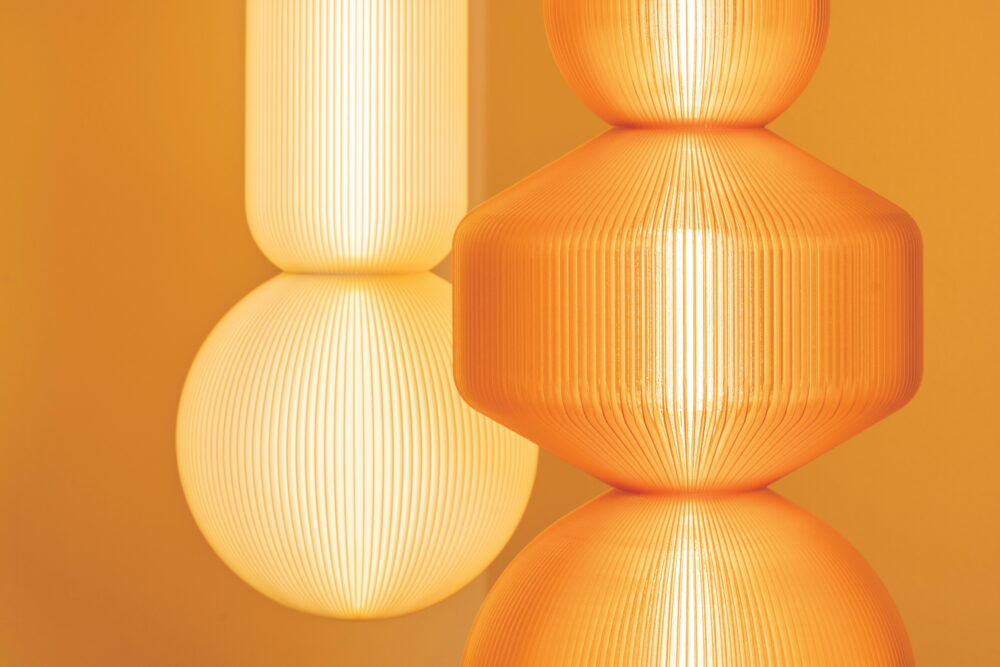
“Noguchi was part of that education with these glowing paper forms that feel like candlelight, moonlight, firelight,” he says. “That emotional DNA is what draws people to light. We wanted to capture that warmth, but translate it into contemporary materials and production.”
What makes Somari different from purely decorative fixtures is how deeply manufacturing technology shaped the design. Rather than designing a form and then figuring out how to make it, LightArt developed the geometry around the capabilities of extrusion-based printing. This resulted in seamless shells, integrated diffusers, and components optimized for both performance and assembly.
“A lot of people think of 3D printing as hobby-level,” Smith says. “But what we’re doing is extrusion. It’s another way of shaping material. The difference is that now we can make any part we want overnight. That changes everything.”
That speed enables iterative prototyping, reduced tooling costs, and unprecedented customization. These are critical advantages in a market increasingly driven by unique architectural applications rather than mass-produced catalog fixtures.
It also opens the door to more human-centric lighting strategies. Somari’s Casper core integrates high-performance LEDs with tunable white options, allowing designers to shift color temperature throughout the day. This aligns with circadian rhythms and wellness-focused design frameworks.
“The future isn’t just about form or efficiency. It’s about adaptability,” Smith says. “How does lighting respond to people, space, mood, and time? Manufacturing has to support that flexibility, not limit it.”
A New Manufacturing Mindset
Taken together, LightArt’s approach reveals a broader shift underway in lighting manufacturing: from rigid production models to adaptive systems; from disposable products to serviceable platforms; and from opaque sourcing to transparent material narratives.
The lesson for designers and architects is about understanding how products are made, how long they last, and what happens when they fail. As Smith puts it:
“If you can’t take it apart, you can’t fix it, and that’s not sustainable.”
For manufacturers, the challenge is even bigger: embracing advanced technologies while preserving craftsmanship, investing in domestic production without sacrificing competitiveness, and designing products that meet both emotional and environmental expectations.
“I think the world is always changing, and we have to change with it,” Smith says. “What excites me is that with these tools, we’re not just reacting; we’re designing a better system from the inside out.”
In an industry long defined by efficiency metrics and price points, that mindset may prove to be the most transformative innovation of all.