



Magic Elek scales into retail with its patented French cable designed to transform renovation, as the market pivots toward low-impact solutions.
In a hurry? Here are the key points to know:
- Retail breakthrough:Magic Elek’s 2026 rollout in Leroy Merlin brings its patented 230V/16A ultra-flat cable into mainstream renovation channels.
- Verified technical profile:11 SKUs, certified (CE, RoHS, TÜV, IEC, UL94), Consuel-approved, 50m weighing just 0.5 kg versus 6.25 kg for traditional cable.
- Renovation impact:Surface-applied, plastic-free system reduces demolition, waste, and installation time, particularly relevant for heritage, timber and occupied buildings.
French manufacturer Magic Elek is preparing a decisive retail rollout through Leroy Merlin, bringing its patented ultra-flat 230V/16A cable to mainstream renovation markets in 2026. Positioned as “the first invisible electrical cable” of its kind, the product is fully manufactured in France, internationally certified, and validated by Consuel. Its promise: electrify without chasing walls, drilling masonry, or generating demolition waste.
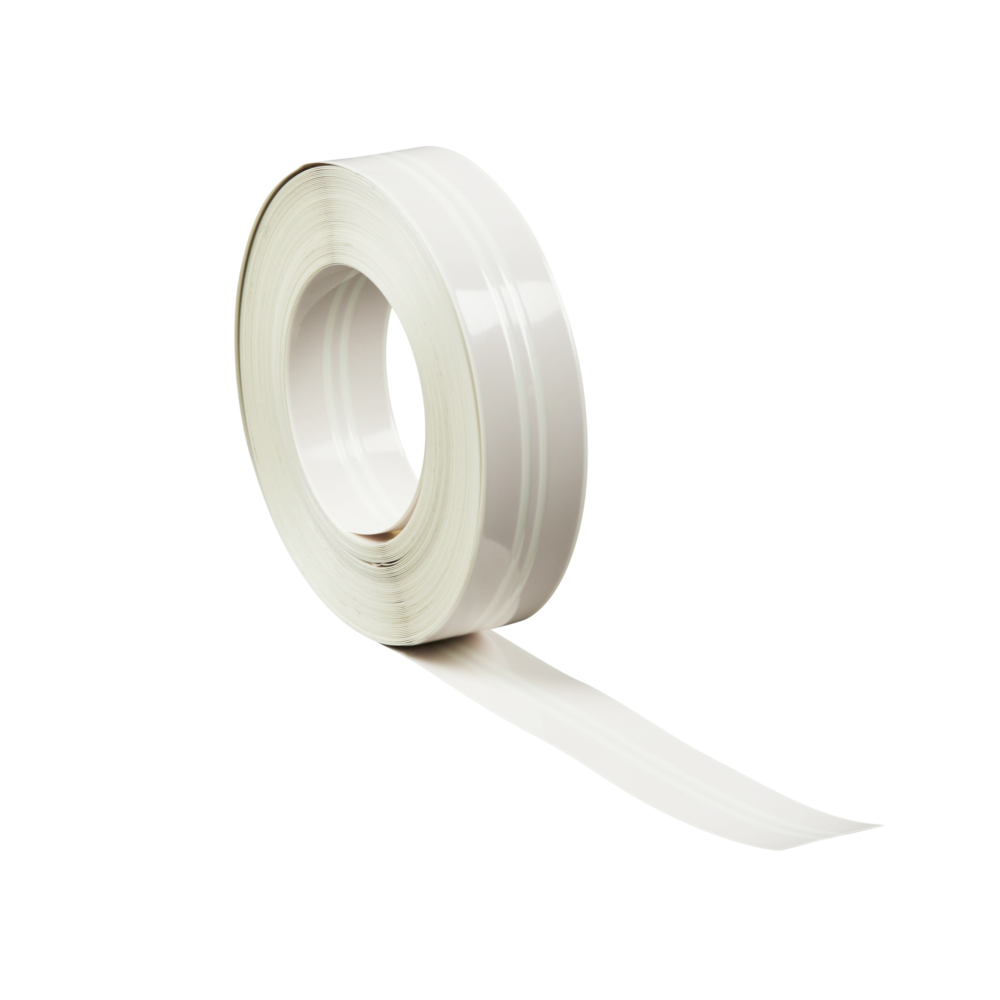
For architects and interior designers navigating increasingly strict sustainability targets, the innovation lies not in higher conductivity or new insulation chemistry but in installation logic. Having reviewed physical samples, we can confirm the cable’s defining feature: a ribbon-like profile only millimeters thick, radically slimmer than conventional round sheathed wiring. It is engineered to adhere directly to surfaces and disappear beneath paint, wallpaper, parquet, tile, or even brick finishing without heavy construction.
Magic Elek can already be purchased in several major retail stores, such as Mr. Bricolage, Castorama, Bricorama, Brico Leclerc, etc. The line is also available now on the website of Leroy Merlin and will be available in the Leroy Merlin store as of May 2026.
Market Shifts in the Electrical Cable Sector
The global renovation cable market is valued at over €200 billion, yet its installation paradigm has changed little in a century. Industry leaders such as Prysmian Group, Nexans, and Southwire focus primarily on grid infrastructure, fire-resistant cabling, and halogen-free compounds. Surface-mounted trunking and PVC raceways offer partial alternatives, but these systems often compromise aesthetics and continue to rely heavily on plastic. In contrast, Magic Elek reframes the equation by redesigning the cable itself.
The company operates along two complementary axes:
- Grand public distribution, reinforced by its upcoming Leroy Merlin presence and partnerships with retailers including Bricomarché, Castorama, and Mr. Bricolage.
- Professional adoption, targeting electricians, decorators, and renovators seeking faster installation cycles and cleaner job sites.
Founder M. Suthan, formerly CEO of Lycamobile, brings experience in large-scale distribution and consumer electronics. His founding observation was deceptively simple: while devices become thinner and invisible, electrical cables remain bulky and intrusive. After more than fifteen years of R&D and patent development, the result is a flattened copper conductor assembly that challenges the dominance of round cables in light renovation contexts.

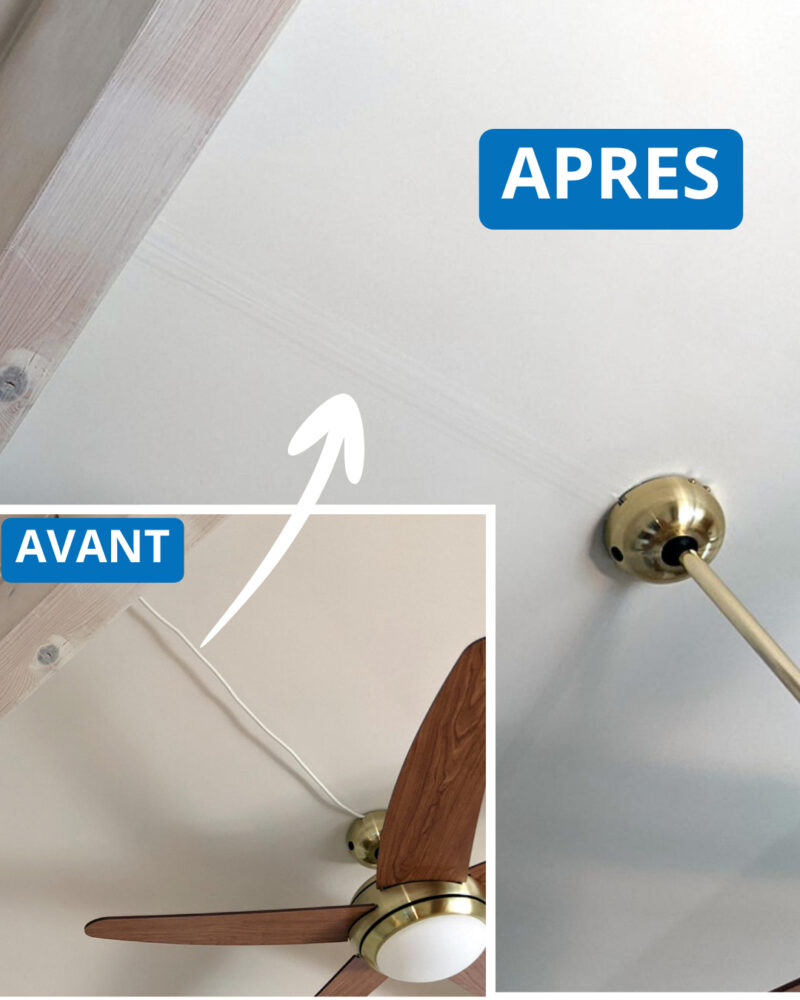
Image: Before (bottom left), and after (top right). Courtesy of Magic Elek.
Engineering the Ribbon: Technology and Product Range
Technically, Magic Elek’s cable is rated at 230V/16A and designed for domestic and light tertiary applications. Its manufacturing process involves multiple stages of copper transformation, such as rolling, flattening, protective layering, assembly, and successive quality controls. The product is produced entirely in France under ISO standards and carries CE, RoHS, TÜV, IEC, IECEE, ETSI, CE/EMC, and UL94 certifications, alongside Consuel validation.
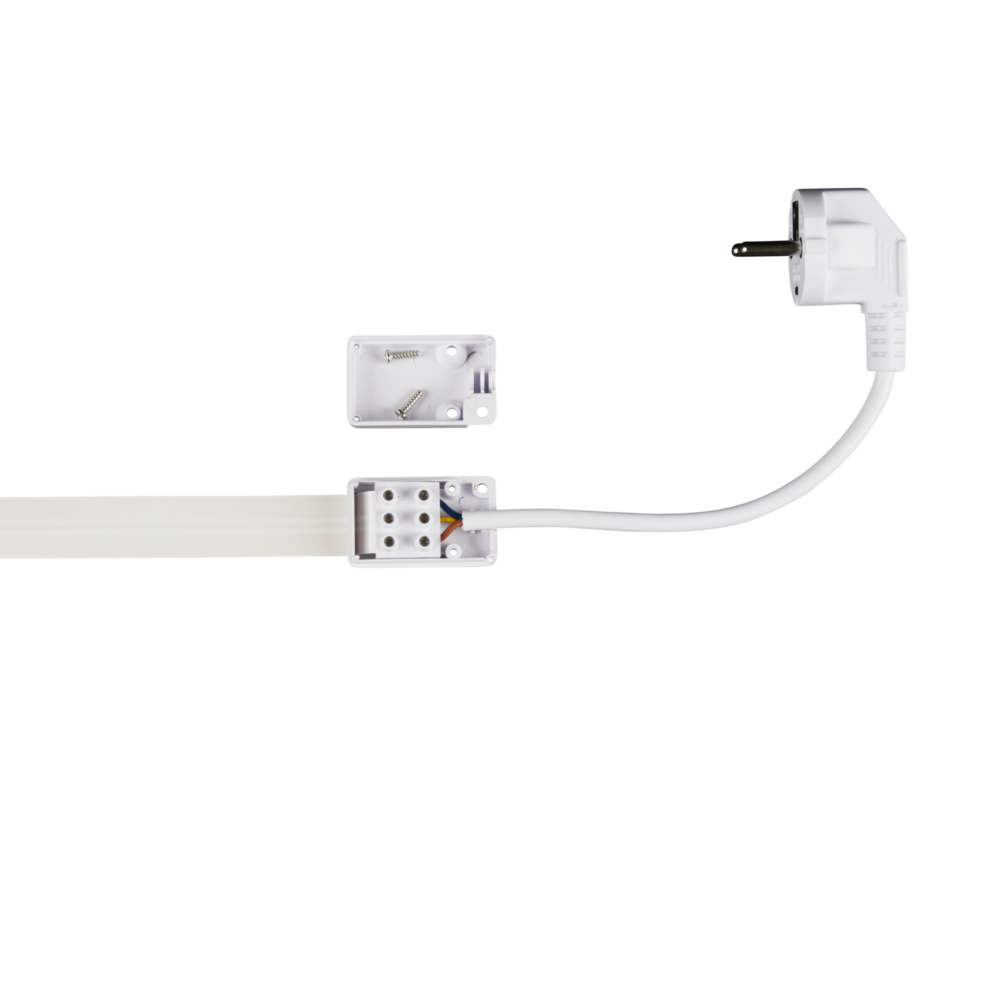
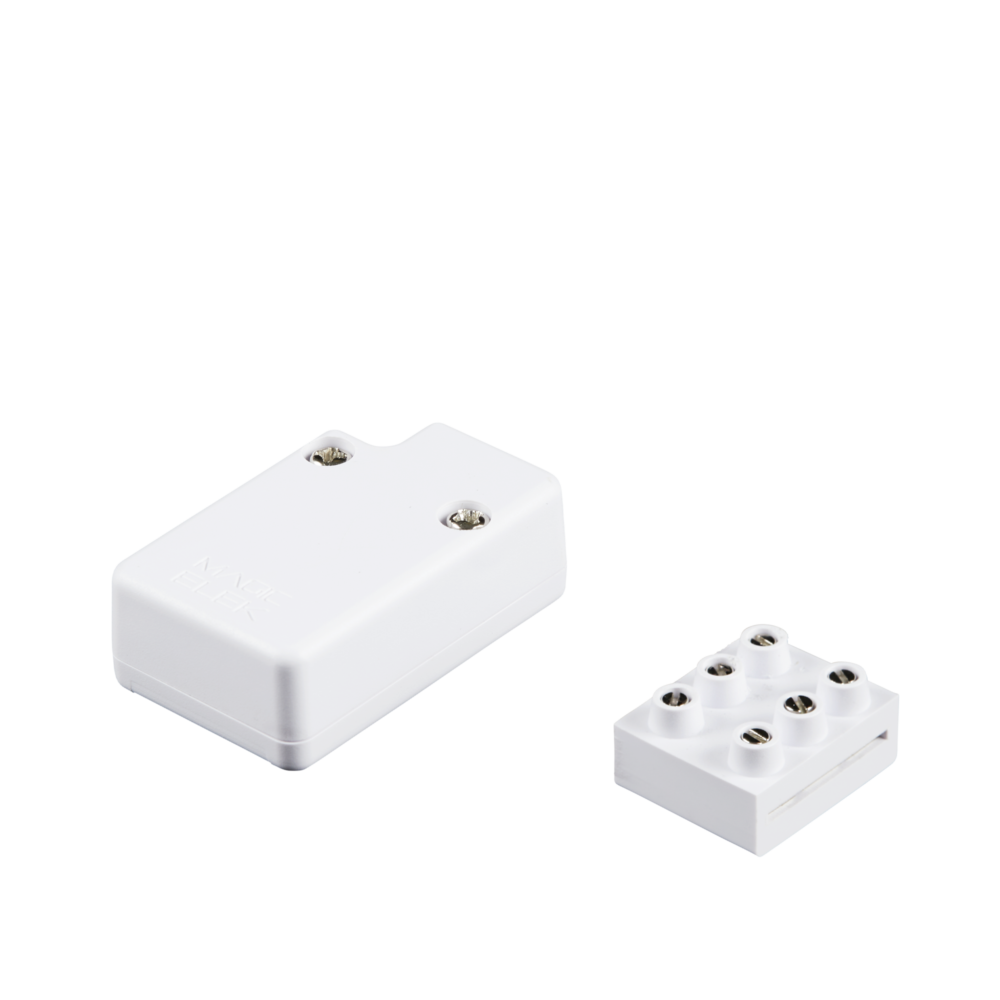
The company currently offers 11 SKUs, including 1m, 2m, 3m, 5m, and 10m lengths. Product configurations include:
- Cable-only formats
- Connection kits (2-line without earth, 3-line with earth)
- Dedicated TV and lighting packs
- Standalone “domino” connectors
Installation is structured around four gestures: cut, fix, bond, and conceal. According to company documentation, installation can be completed in approximately three minutes for standard applications.
A striking comparative metric underscores the material efficiency:
- 50 meters of traditional cable: 6.25 kg, 8,664 cm³
- 50 meters of Magic Elek: 0.5 kg, 288 cm³
For designers managing constrained spaces or logistics-heavy urban projects, this reduction in weight and volume may have non-trivial implications. It clearly impacts transport emissions as well as storage and on-site handling.
Applications range from wall-mounted televisions and luminaires to projectors, radiators, ventilation systems, cameras, and lightweight appliances. Crucially, the cable can be concealed under paint layers, wallpaper, parquet, carpet, or tile, expanding possibilities for heritage buildings or timber structures where chasing is restricted or structurally inadvisable.
Unlike large-scale cable manufacturers optimizing for megaproject infrastructure, Magic Elek’s competitive advantage lies in architectural integration: minimal visual footprint, reduced plastic use, and surface adaptability.
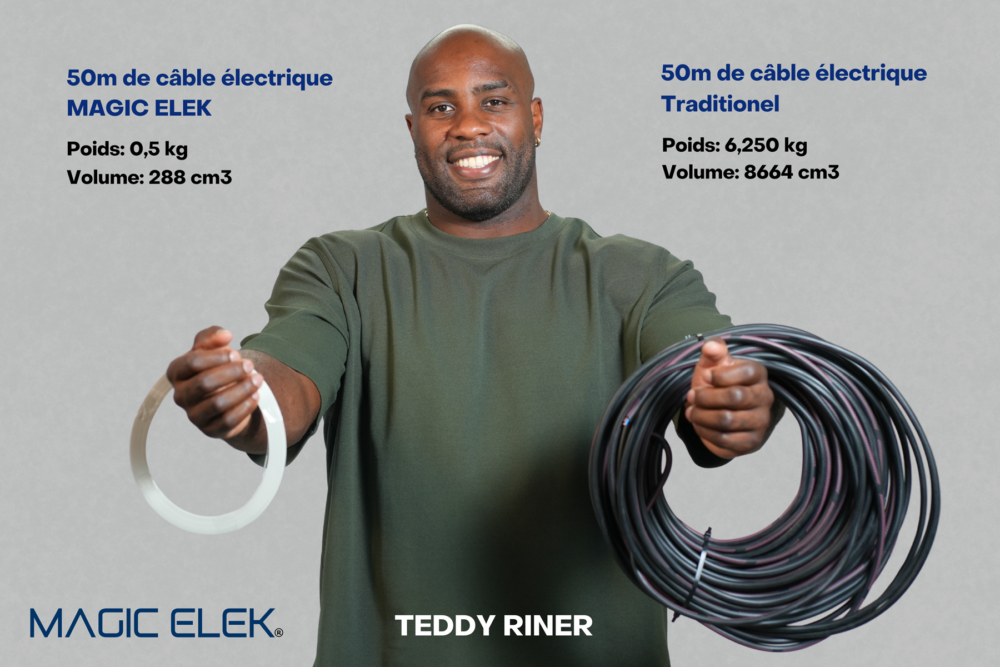
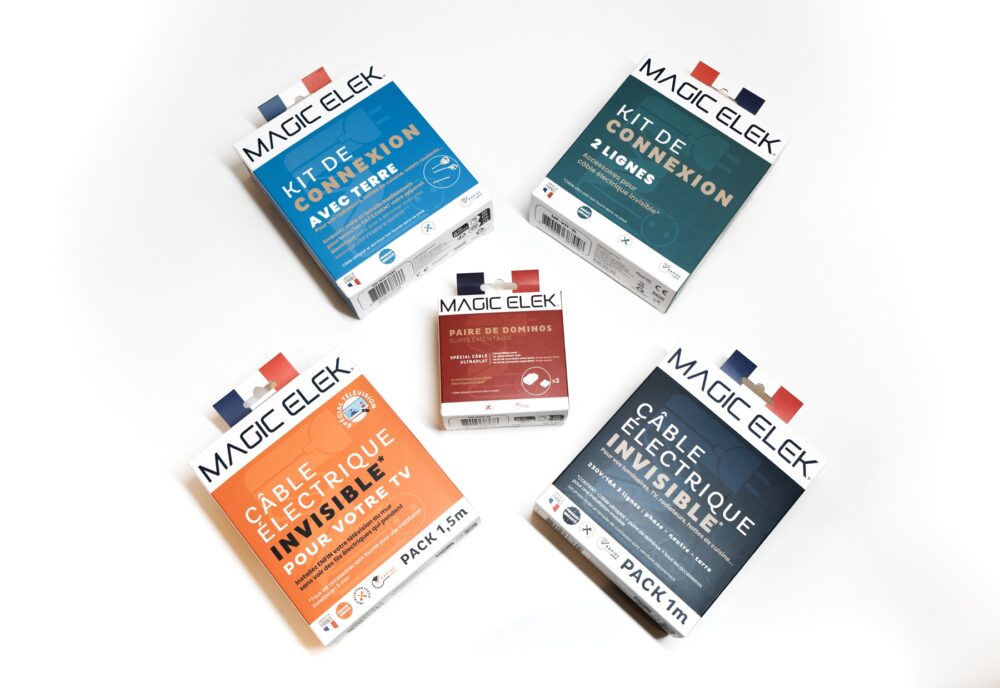
Image (left): 50m electric cables from MAGIC ELEK (weight: 0.5kg / volume: 288cm3) compared to 50m electric cable as traditionally seen on the market (weight: 6.25kg / volume: 8664cm3)
Renovating Without Breaking: Ecological and Economic Leverage
Across Europe, renovation is no longer purely aesthetic; it is regulatory and environmental. Demolition waste accounts for a substantial portion of construction debris, and rewiring traditionally entails masonry cutting, dust, extended labor time, and material disposal.
Magic Elek positions itself within the growing “light renovation” movement. By eliminating wall chasing and plastic conduits, it reduces debris generation and shortens installation timelines. The system requires no additional energy input during installation, as manual application suffices.
For architects working on listed properties, wooden constructions, modular housing, or tertiary interiors requiring operational continuity, this low-disruption model is particularly relevant. Reduced downtime translates directly into financial savings for commercial clients. The company claims installations can be up to ten times more economical compared to traditional embedded rewiring, depending on scope and labor conditions.
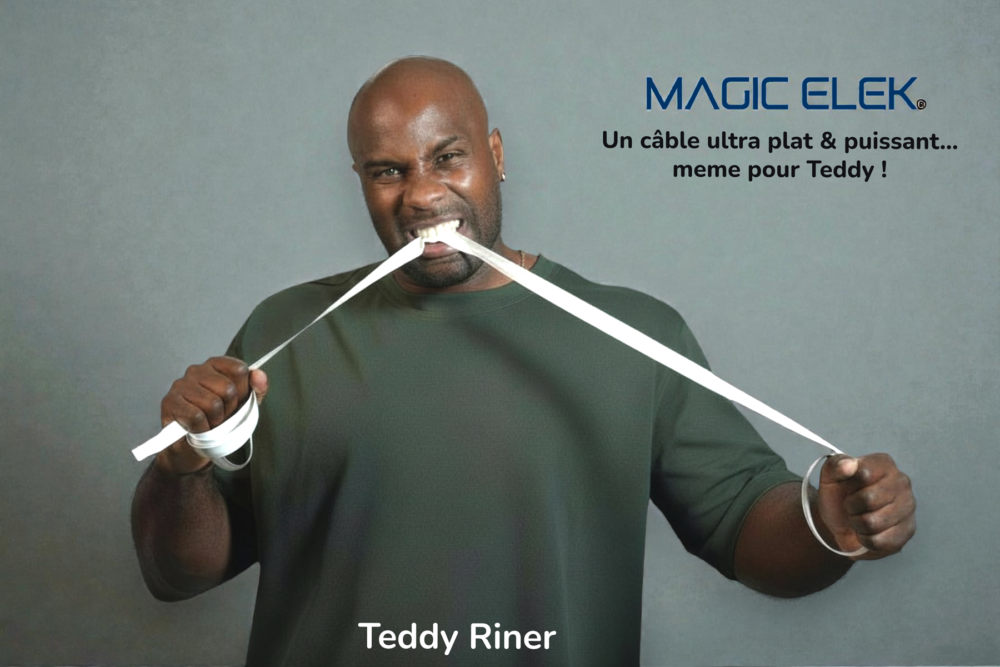
The brand’s partnership with Olympic judoka Teddy Riner underscores its positioning around durability and national manufacturing pride. More structurally significant, however, is its retail expansion. Distribution through Leroy Merlin and established GSB networks signals scalability, a crucial threshold for any construction innovation seeking specification-level adoption.
International ambitions target Europe, the United States, and emerging markets, while maintaining full French production. The leadership team includes executives with backgrounds at ENGIE, Amazon France, ManoMano, and major retail networks, reinforcing the company’s distribution-driven growth model.
A Design Question, Not Just a Technical One
For construction professionals, the key question is not whether ultra-flat cables will replace round cables universally—they will not in high-load or infrastructure-scale contexts. The more pertinent inquiry is where they make sense.
In renovation scenarios, prioritizing:
- Minimal structural intervention
- Material sobriety
- Visual discretion
- Rapid installation
Magic Elek presents a compelling case study in how incremental technical redesign can yield systemic site-level change. In a sector seeking alignment between ecological responsibility and design integrity, the innovation may not be the electricity itself but the absence of what once surrounded it.