


How telehealth cabins and kiosks are redefining healthcare architecture through neuroaesthetics, medical-grade materials, and spatial innovation.
In a hurry? Here are the key points to know:
- Telehealth cabins are a new healthcare typology:It requires architects to merge clinical standards, acoustic performance, and neuroaesthetic principles within compact environments.
- Material compliance is non-negotiable:Designers must specify medical-grade, antimicrobial, fire-rated, and chemically resistant surfaces from reputable healthcare manufacturers.
- This is infrastructure, not trend:Driven by physician shortages and telemedicine expansion, teleconsultation cabins represent a durable, scalable architectural market requiring new spatial thinking.
As healthcare delivery decentralizes, a new typology is quietly entering pharmacies, retail spaces, workplaces, and transit hubs: the telehealth cabin. For architects and designers, this is not a gadget story. It is a spatial one. These compact, self-contained medical environments must reconcile clinical rigor with psychological comfort, technological integration with architectural restraint.
The rise of teleconsultation booths and kiosks across France—accelerated by physician shortages and regulatory support—signals a broader shift in how care is accessed. Companies like Tessan have deployed thousands of units nationwide, but their latest 2025 Premium cabin emphasizes an important point: design is no longer secondary to technology. It is central to the healthcare experience itself.
For architects and designers, the question is not whether telehealth spaces will multiply. It is how to design them responsibly. As neuroaesthetics research increasingly demonstrates, the built environment measurably affects stress, cognition, and perceived wellbeing. Healthcare architecture, even at the scale of a cabin, now carries neurological consequences.
Telehealth Cabin Typologies and the Design Logic Behind Tessan’s Premium Model
Telehealth infrastructure today generally falls into three typologies:
- Open kiosks or wall-mounted consoles integrated into pharmacies or public settings
- Semi-enclosed pods providing acoustic and visual privacy
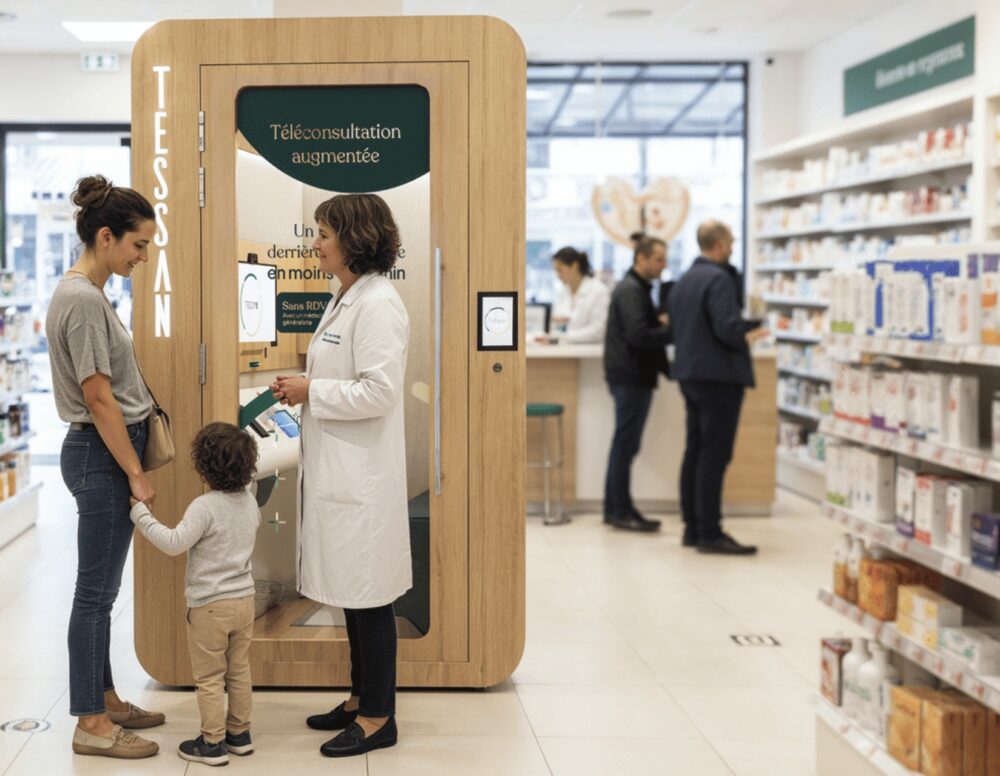
- Fully enclosed medical cabins, such as Tessan’s Premium model
The Premium cabin, developed in collaboration with Lithuanian design firm TAOS, represents a maturation of the typology. Rather than resembling a technical booth, it is conceived as a controlled micro-clinic.
TAOS emphasizes several architectural responses to healthcare constraints:
- Electrochromic glass door with automatic opacity, ensuring immediate visual privacy
- Acoustic insulation up to –28 dB, critical in high-traffic pharmacy environments
- Integrated UV disinfection system, automating hygiene cycles
- Antibacterial textiles and medical-grade finishes
- Compact but ergonomically optimized interior layout

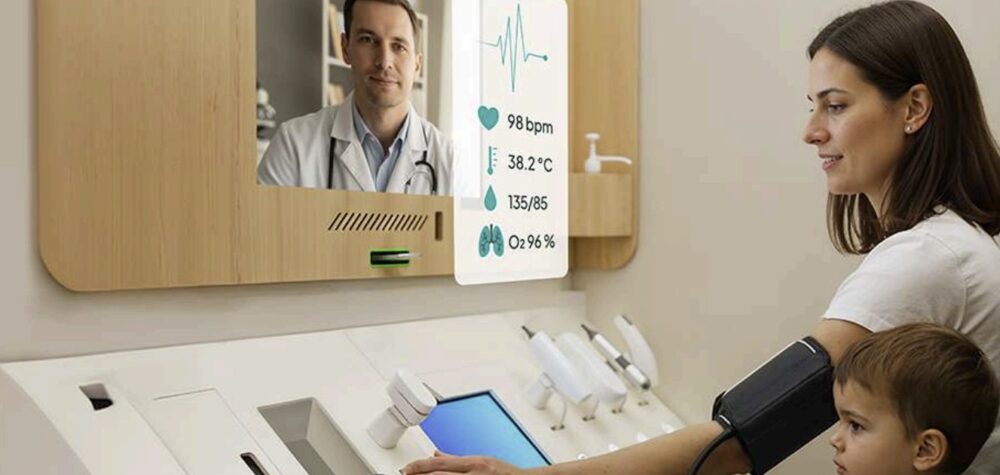
The use of warm wood finishes and calibrated LED lighting is particularly noteworthy. Neuroaesthetic principles suggest that biophilic cues, material warmth, and indirect lighting reduce cortisol levels and perceived clinical anxiety. In other words, design is not cosmetic. It modulates physiological stress responses.
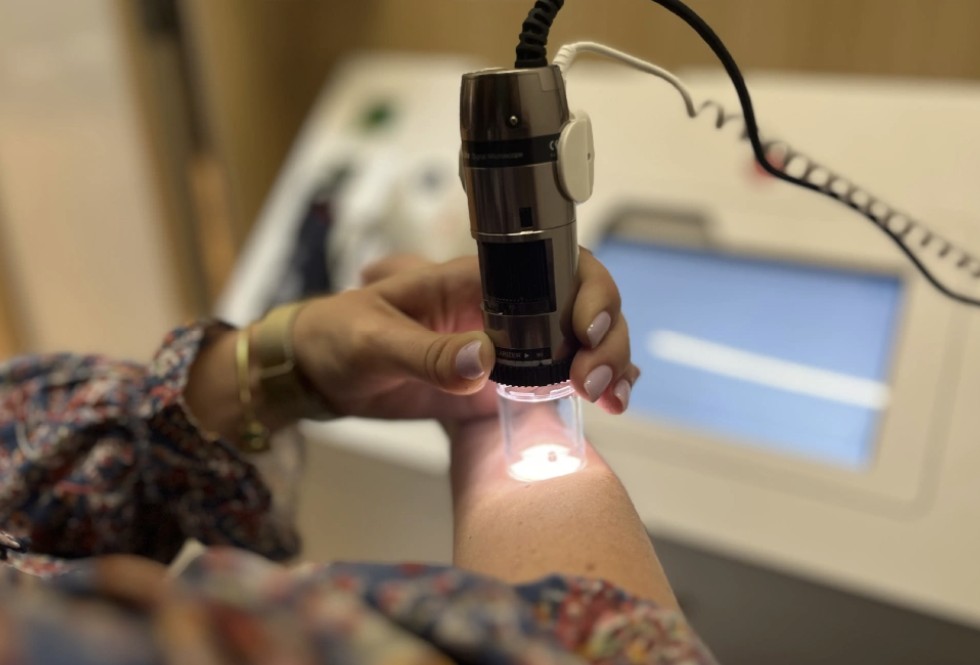
The cabin must perform dual roles: evoke reassurance while signaling clinical legitimacy. Too sterile, and it alienates; too domestic, and it undermines medical authority. The Premium cabin navigates this balance through restrained material palettes and visible integration of connected medical devices (stethoscope, dermatoscope, otoscope, etc.), maintaining trust in the clinical act.
For designers, this typology demands thinking at the intersection of furniture design, medical architecture, and industrial engineering.
Medical-Grade Materials: Designing for Compliance and Safety
Designing a telehealth cabin is not equivalent to designing a retail pod. Healthcare environments are governed by hygiene, fire safety, durability, and chemical resistance requirements.
Architects specifying materials for teleconsultation spaces should prioritize:
- Non-porous, antimicrobial surfaces
- Chemical-resistant laminates
- Seamless flooring systems
- Textiles compliant with healthcare antibacterial standards
- Fire-retardant certifications (European EN standards or equivalent)
Several established manufacturers specialize in medical-grade materials suitable for such environments:
- Tarkett – Healthcare vinyl and homogeneous flooring solutions
- Forbo Flooring Systems – Marmoleum and Sphera lines for clinical settings
- DuPont – Corian® solid surfaces widely used in hospitals
- Kvadrat – High-performance textiles including healthcare applications
- 3M – Antimicrobial films and surface protection technologies

Compliance extends beyond materials. Ventilation, cleanability, and maintenance protocols must be integrated from the earliest design phase. UV disinfection systems, like the one integrated into Tessan’s Premium cabin, require careful spatial calibration to avoid material degradation while ensuring microbiological efficacy.
For architects, due diligence means verifying CE markings for integrated medical devices, confirming resistance classifications, and ensuring that selected suppliers understand healthcare regulatory environments, not merely aesthetic expectations.
Designing for a Growing Market: Strategic Considerations for Architects
Teleconsultation cabins are no longer experimental. In France alone, thousands have been deployed, and market demand is increasing due to structural physician shortages and government efforts to expand telemedicine access.
For architects, this signals opportunity and responsibility.
First, context integration is critical. Telehealth cabins may be inserted into pharmacies, shopping centers, transportation hubs, or corporate campuses. Each context imposes acoustic, circulation, and visibility challenges. Designers must anticipate user flow, privacy thresholds, and ADA (or European accessibility equivalent) compliance.
Second, modularity and scalability matter. Teleconsultations are expanding into tele-expertise, as in dermatology and chronic disease monitoring. Cabins may require additional imaging equipment or remote diagnostic tools. Flexible infrastructure allows future retrofitting without structural redesign.
Third, psychological signaling deserves equal weight to technical compliance. A teleconsultation cabin represents a liminal space: neither hospital nor home, neither public nor private. Designers must choreograph transitions—entry thresholds, lighting gradients, acoustic dampening—to help patients psychologically shift into a clinical mindset.
Antoine Ducrocq of Tessan has emphasized that the market for teleconsultation booths continues to grow as millions of French residents remain without regular access to a primary physician. For architects, this underscores that these structures are not temporary installations but emerging healthcare infrastructure.
Architectural Innovation at Micro Scale
The Premium cabin illustrates a broader lesson: healthcare’s decentralization requires architectural innovation at micro scale. Telehealth cabins compress the complexity of a consultation room into a few square meters. Every centimeter matters.
The future of healthcare will not be built exclusively in hospitals. It will unfold in pharmacies, transit corridors, and hybrid civic-commercial spaces. For architects and designers, telehealth cabins represent a new frontier: spaces where industrial precision meets human vulnerability.
Designing these environments demands more than compliance. It requires understanding neuroaesthetics, material science, acoustic engineering, and behavioral psychology—within a footprint smaller than a walk-in closet.
In this emerging realm, architecture does not merely house care. It becomes an active participant in delivering it.