




What if a work of art could set off a chain of sympathetic resonances within our nervous systems that bring our aural and visual senses into a synesthetic state of ethereal ecstasy?
The early twentieth-century Russian composer Alexander Scriabin sought to induce such a transcendent sensory state in audiences with his tone poem Prometheus: A Poem of Fire Op 60 (1910). While composing the work, he charted what he believed were underlying correspondences between sound and light waves. He had a special color organ, the clavier à lumieres, designed to illuminate a screen behind the orchestra in New York City in 1915 with a kaleidoscope of changing colors calibrated to follow changing chords in the music, which was one of the first multimedia events.
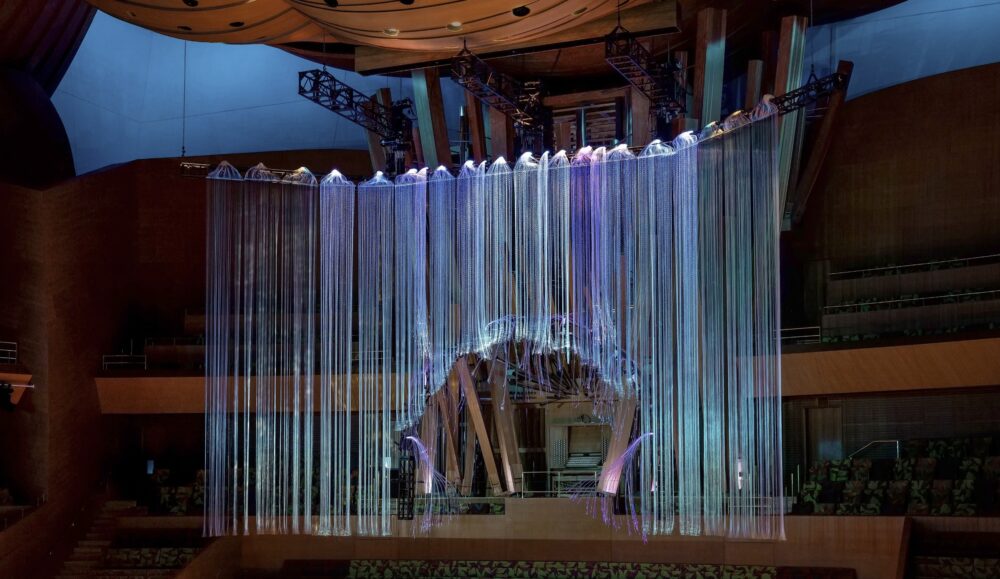
Unfortunately, the relatively primitive lighting technology of the day was not up to the task, and the clavier à lumières was not included in subsequent performances. However, in early January of this year New York City-based lighting artist Grimanesa Amoros honored Scriabin’s vision with an enormous LED light sculpture titled Radiance that bathed Frank Gehry’s iconic Walt Disney Hall with a sequence of changing color and light intensity that followed the score of Prometheus during a limited run of performances by the Los Angeles Philharmonic, which was conducted by the maestro Esa-Pekka Salonen.
Tubes of Glowing LED Lights
Radiance is the latest high-profile project by Amoros, who, over the past several decades, has created lighting sculptures all over the world. But until the debut of Radiance, most of her work has consisted of standalone public art or installations engaged in dialogue with the architecture of iconic buildings. In the past year, she has wrapped the landmark clock tower atop the Peninsula Hotel in Istanbul with a work called A Wave of Time, which consisted of two installations: Maritime, a sculpture in the hotel lobby, and Passage, which was comprised of tubes of glowing LED lights that transformed the tower into a beacon along the Straight of The Bosphorus.
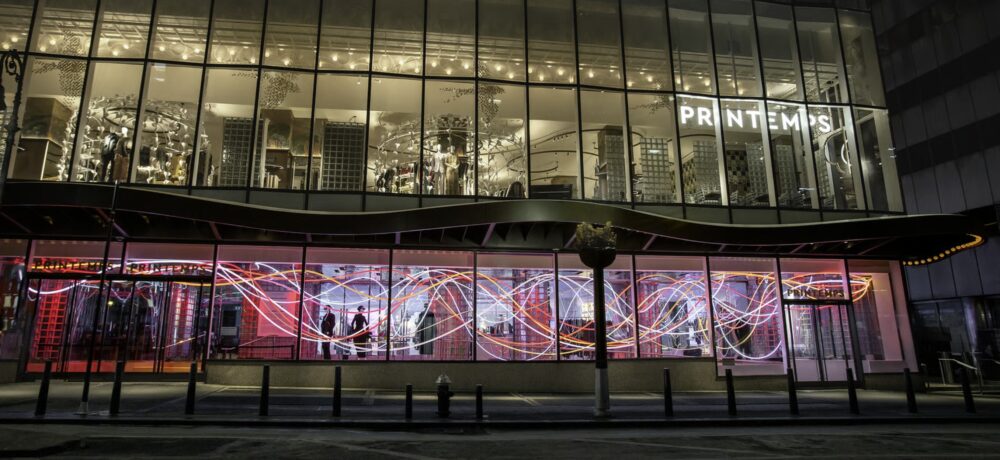
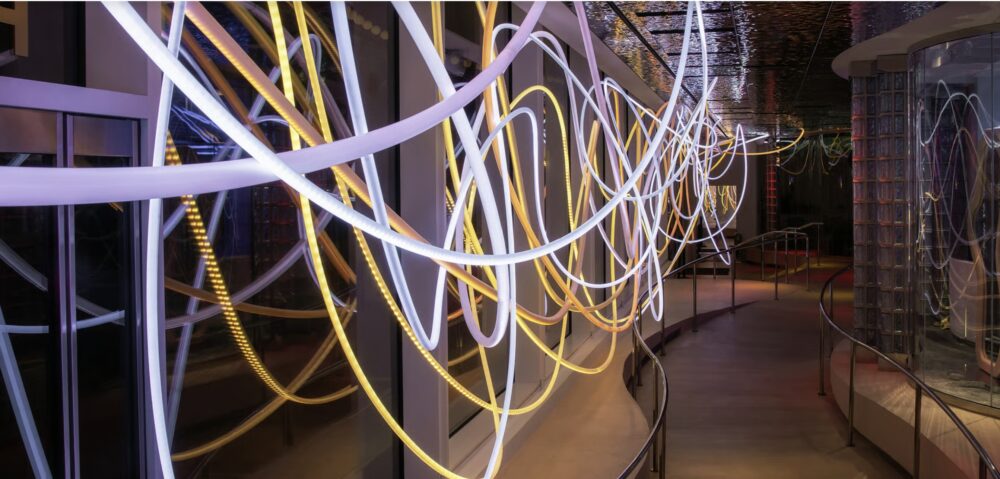
For Amoros’s 2026 work Perfect Timing, she filled the store windows of the Manhattan branch of the Parisian department store Printemps with a sculpture consisting of curvilinear light tubes with filled with LEDs that were programmed in a sequence of shifting colors and intensities designed to respond to the sinuous architecture of the Art Deco landmark. Through its sequenced light display, Perfect Timing also captures the rhythms of the streets of New York City and elements such as streetlights in a manner that harks back to the buoyant scenes of urban life conveyed by dabs of color in Camille Pissarro’s Boulevard Montmartre series.
An Array of Dangling Rope-like Tubes with LEDs
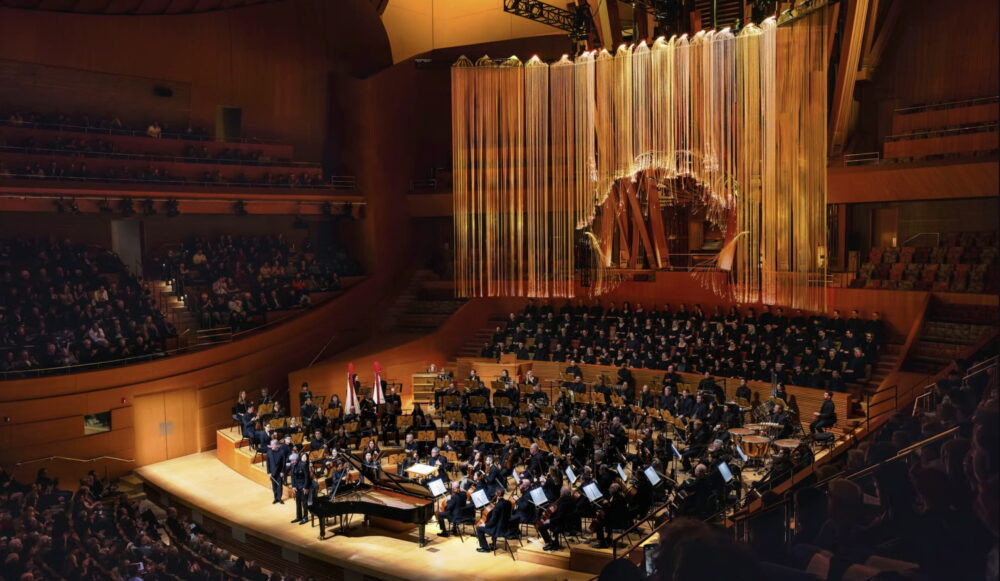
But Radiance at the Walt Disney Hall is one of Amoros’s boldest works yet. The sculpture consisted of a massive array of dangling rope-like tubes containing LEDs, as well as reflective surfaces placed throughout the hall that formed a backdrop to the chorus and the orchestra. Amoros says that her intention was:
“to create a dialogue between light, space and sound,” adding, “It’s also Frank Gehry’s hall, so you must be careful of how the light hits the architecture.”
Amoros doesn’t know how to read music, but she studied a recording of Prometheus, and then she spent ten days at her computer coding and composing distinctive shades of blues, lavenders, and a shade of emerald, green that she says cannot be captured by a camera. The sequence of changes in light intensity and in color was matched to the score of the tone poem in quite a different manner from Scriabin’s color-coded chart, but in a way that she felt captured the essence of the music. She also took additional artistic license in incorporating gold-hued light to reference the Incan god Viracocha from her native country Peru, noting in her artist statement that “both godly figures Prometheus and Viracocha symbolize the act of working with illumination as a pursuit of knowledge and enlightenment.”
For the actual performance of the Los Angeles Philharmonic, Amoros was seated far backstage at the light controls with an assistant conductor who helped her adjust her light composition in real time to complement the symphony, which can vary slightly in length from night to night depending on how it is conducted.
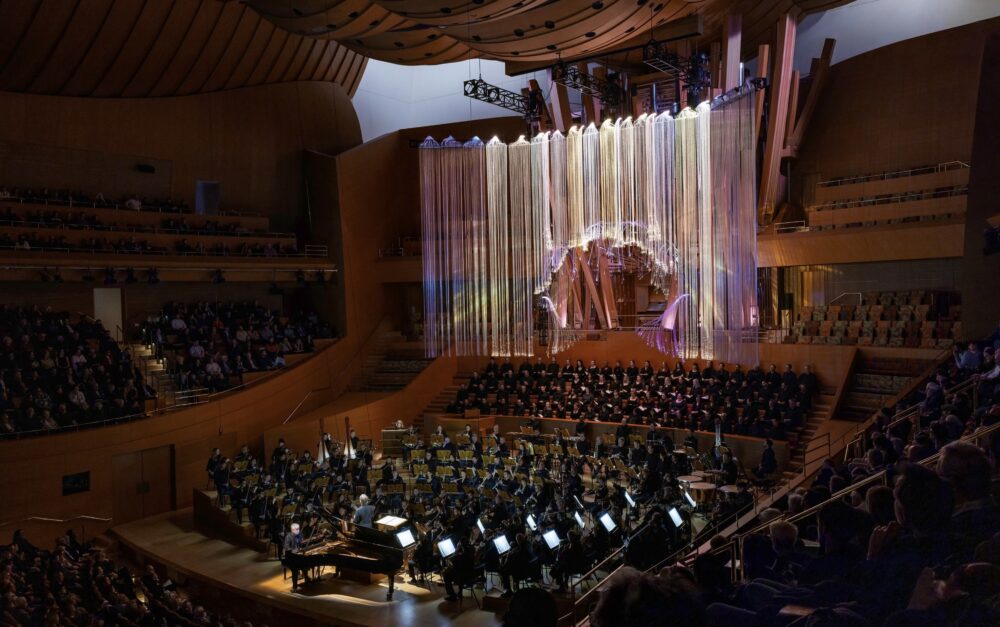
“It’s important to be precise,” she says, “for example, the part that Prometheus is giving fire to humanity, where the orchestra is in full motion, very passionate and very intense. So that’s the time that the light also has to go wild because if you’re off, it wouldn’t work.”
At that point, all of a sudden, the orchestra goes black, and the theater sidelights go white, illuminating the audience and sending the message about Prometheus’s gift to humankind.
A critical issue was to tailor the light sculpture to the music, a true balance of the two mediums.
“I wanted to enhance the sound and not distract the viewer, it was important to make them experience the sound and conducting of Esa-Pekka, Amoros says, “The sculpture was so large it could have overtaken the orchestra.”
Dismantled and Recycled: Constructing Light Sculptures with Purpose
One of the striking things Amoros’s light sculptures is that although they are generally quite big, most are temporary installations and quite sustainable, especially compared to material-based sculptures of stone or metal.
“I use LEDs which consume very small amounts of power,” Amoros says, adding that after a desingated run time, often lasting several months, they are dismantled and the components reycled in other works or donated for re-use to an institution such as a hospital.
For Amoros, who typically uses her lighting sculptures to highlight or bring to life hidden aspects of public spaces and distinctive buildings, working with a work of music was a longtime dream and one that underscores her method for constructing light sculptures.
“I basically do the light sequence like a conductor,” she says, noting that she counts a specific number for every color she programs into a sculpture, “ta, ta, ta—every second is changing and I am often doing sequencing to music, so for me it [the Prometheus performance] was the perfect fusion of light and sound.”