


At Maison&Objet Paris, three glassmakers revealed the ever-evolving industry of glass through fragile engineering techniques, crystal that resembles stone, and artistic depths through layers.
By 2026, glass has moved decisively beyond its historical role as a supporting material. Research and experimentation throughout 2025, spanning smart glass, material hybridization, and energy-conscious furnace innovation, have laid the groundwork for a new era in glass-making, one where craft, science, and artistic intuition converge.
At Maison&Objet Paris 2026, this evolution was palpable. Within an installation curated by Elizabeth Lerich, three French glass artisans—Romain Glorieux, Jean-François Lemaire, and Jonathan Ausseresse—offered a forward-looking vision of glass as sculpture, furniture, and interior object, each pushing the medium toward uncharted expressive and technical territory.
Romain Glorieux — Engineering Fragility
Romain Glorieux’s work embodies one of the most significant trajectories emerging from 2025 research: material convergence. With three decades of experience working with glass, Glorieux has spent the past six years developing a proprietary technique that allows him to fuse glass with earthenware. These two materials are historically considered incompatible due to their radically different drying and firing requirements. The result is not a compromise, but a new material language altogether.
Encountered at Maison&Objet 2026, his pieces read as architectural fragments: glass appears anchored, weighted, almost geological, while earthenware gains an unexpected luminosity. This dialogue between opacity and transparency reflects broader post-2025 explorations into hybrid surfaces and tactile depth, yet Glorieux’s approach remains resolutely artisanal, developed through trial, failure, and furnace intuition rather than industrial shortcuts.
Now preparing monumental works reaching 1.20 meters in height for Révélations Paris, Glorieux is scaling his technique without losing its fragility. The challenge is both structural and conceptual: how to preserve the tension between materials as size increases. In conversation at his stand, it became clear that this tension, between control and risk, is central to his practice.
Looking ahead, Glorieux’s work suggests a future where glass is no longer treated as a singular medium but as a binding agent, capable of absorbing and transforming other materials. In an era increasingly defined by cross-disciplinary design, his practice positions glass as both structure and skin.
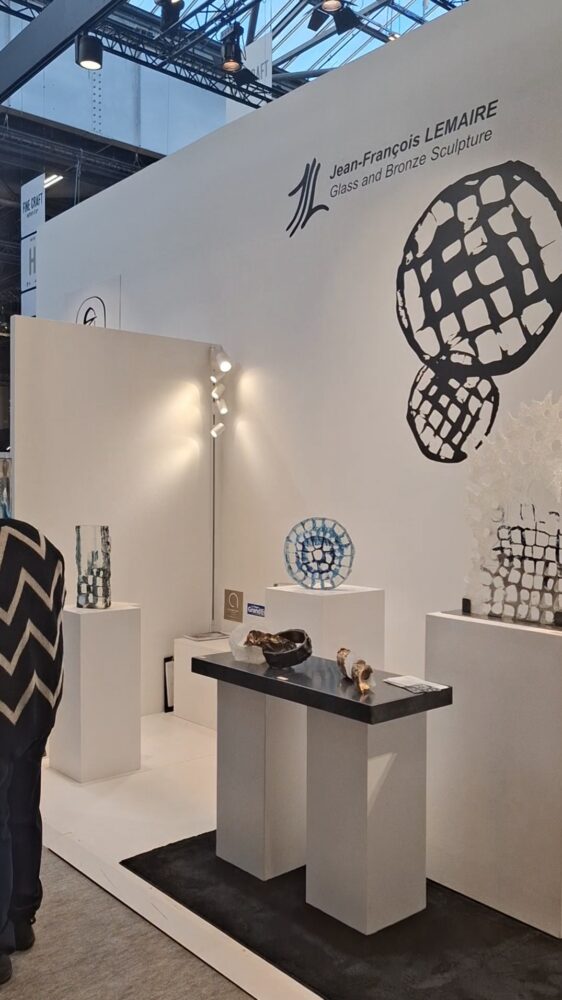
Jean-François Lemaire — When Crystal Becomes Stone
If 2025 was marked by renewed interest in glass’s geological origins, Jean-François Lemaire’s work at Maison&Objet 2026 took that inquiry several steps further. Self-taught and sculpting for 45 years, Lemaire operates with a rare technical arsenal: at least five distinct ovens, each dedicated to different materials, from glass and crystal to metal. This multiplicity of heat sources is not excess; it is essential to his process.
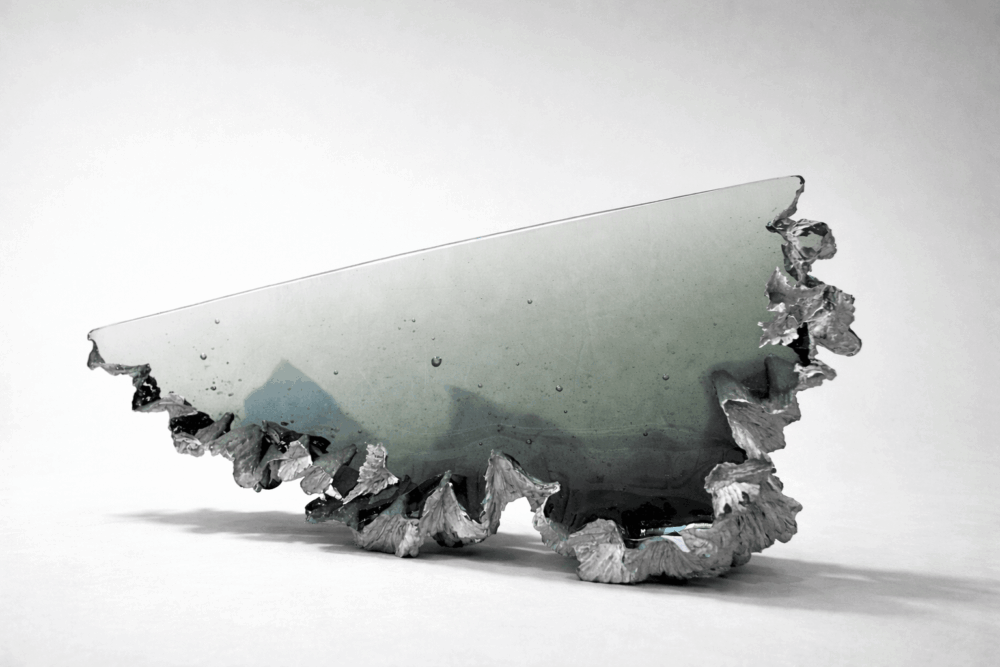
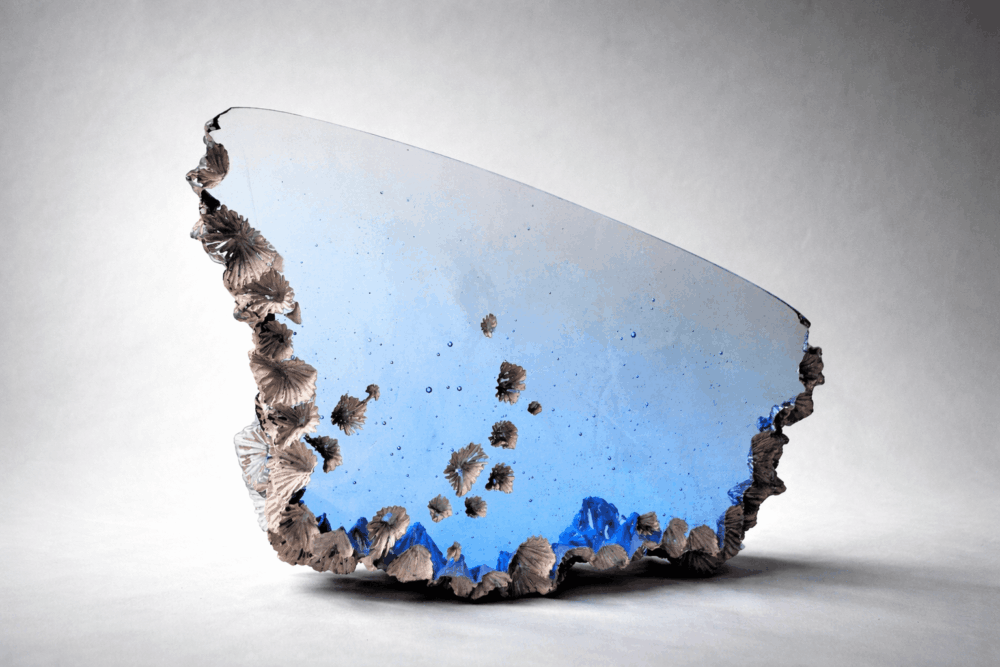
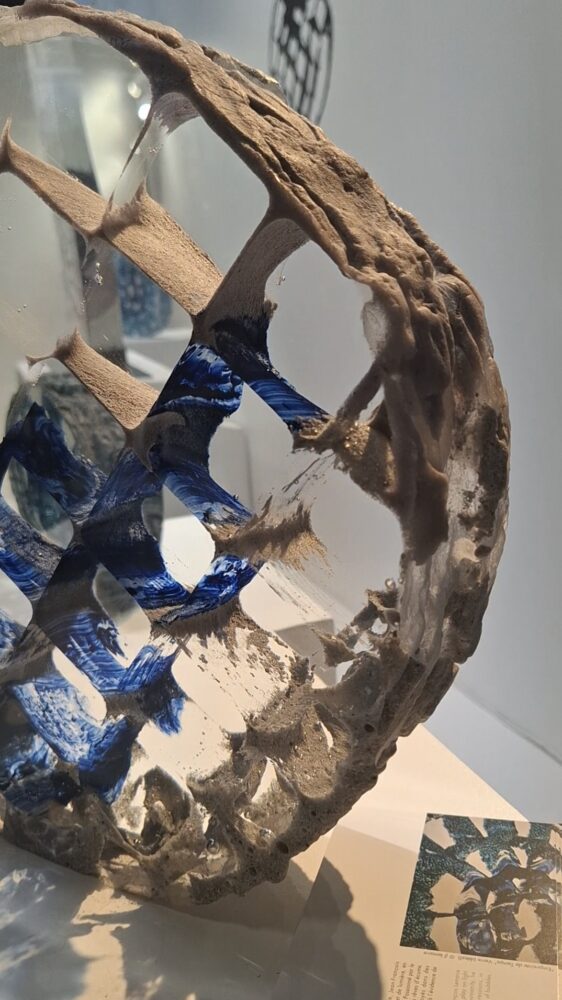
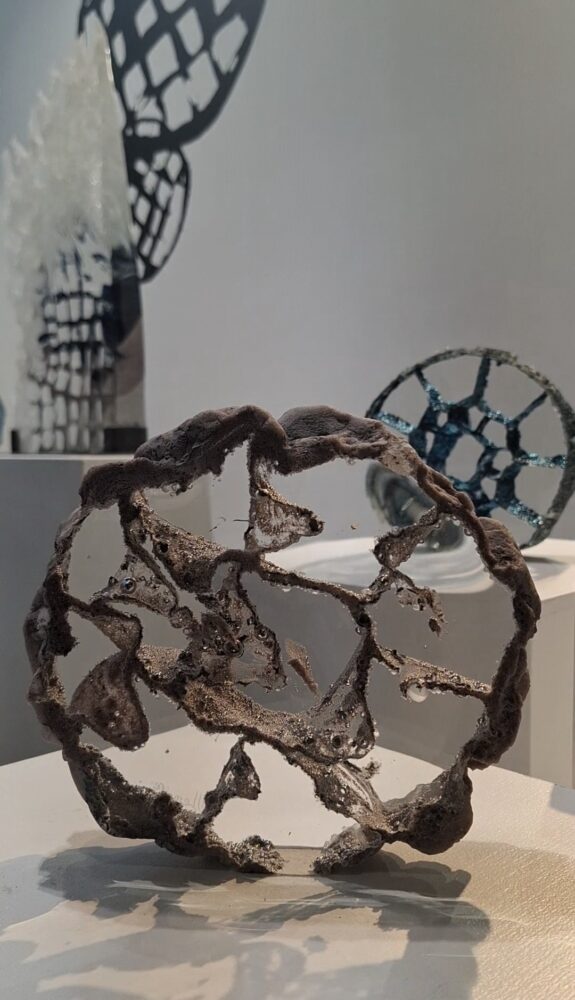
Lemaire works primarily with glass and crystal, yet his most compelling innovation lies in a technique that transforms crystal into a material that visually and tactually resembles rock. The brilliance traditionally associated with crystal is subdued, compressed, and reconfigured into dense, mineral-like forms. Light still exists within the pieces, but it is trapped, diffused, and fractured—more subterranean than radiant.
Discussing his work at the fair, Lemaire emphasized time as a sculptural tool: prolonged heating, controlled cooling, and repeated firings allow the material to lose its ornamental identity and gain mass. This approach resonates strongly with post-2025 research into slow processes and energy-aware firing cycles, even as his practice remains deeply physical and instinctive.
Looking forward, Lemaire’s work challenges one of glass’s most entrenched assumptions that its value lies in transparency. Instead, he proposes opacity, weight, and resistance as equally powerful expressions. In doing so, he aligns glass sculpture with landscape, archaeology, and permanence.
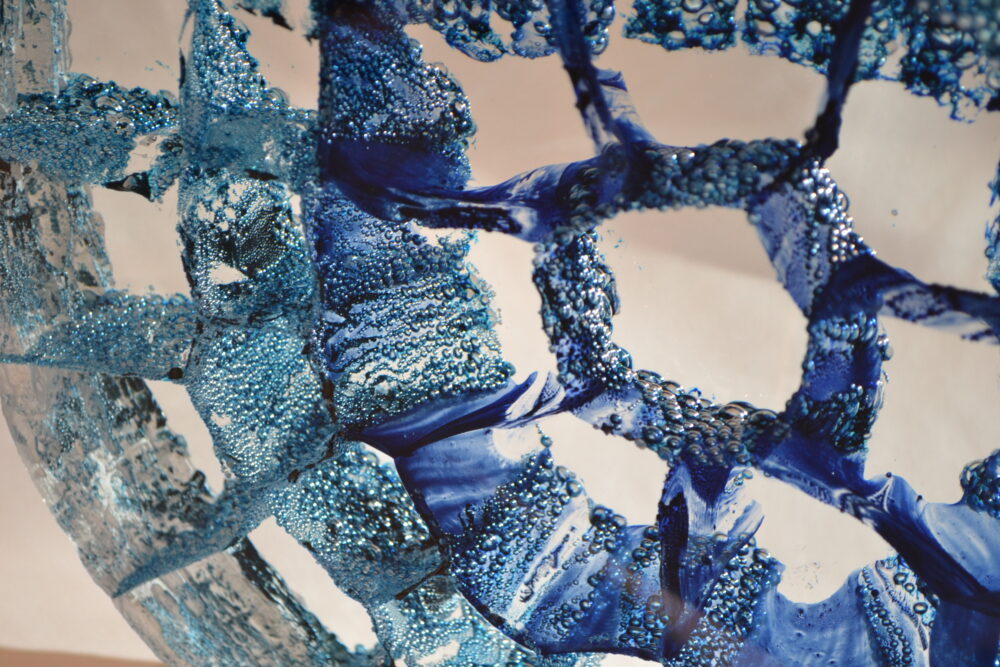
Jonathan Ausseresse — Mastering Chance Through Layers
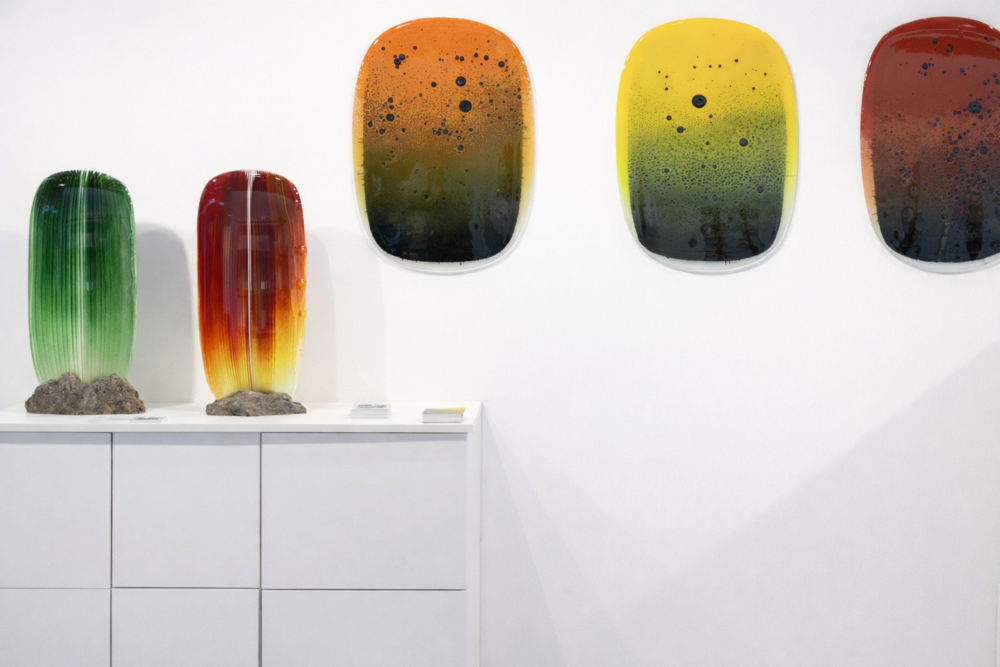
Jonathan Ausseresse’s work represents another key direction emerging from late-2025 experimentation: the controlled embrace of unpredictability. His technique is built on superposed layers of glass, stacked and fused in ways that allow chance interactions between color, air, and heat to assert themselves. Yet nothing here is accidental; unpredictability is designed into the process.
At Maison&Objet 2026, two distinct bodies of work made this duality clear. His sculptural pieces are smooth, refined, and tightly controlled, emphasizing clarity of form and optical precision. In contrast, his glass “paintings” abandon restraint, embracing turbulence, distortion, and painterly gestures within the material itself.
What connects these typologies is Ausseresse’s nuanced manipulation of transparency versus opaqueness. Layers accumulate, obscure, and then unexpectedly reveal internal events frozen in glass. This echoes broader post-2025 investigations into layered glass for architectural and interior applications, yet Ausseresse keeps the scale intimate, inviting close viewing rather than distant spectacle.
Speaking with him at the fair, it became evident that his practice treats glass less as an object and more as a record of process. Each layer documents a decision, a reaction, or a moment of surrender to heat, creating alternating depths.
Looking ahead, Ausseresse’s work suggests a future where glass becomes increasingly expressive—less polished, more honest—capable of holding both mastery and vulnerability within the same surface.
The Shape of Glass to Come
As 2026 unfolds, glass stands at a pivotal moment. The innovations and studies of 2025 provided new tools, efficiencies, and possibilities, but it is through artisans like Glorieux, Lemaire, and Ausseresse that these advances find meaning. Their work, encountered firsthand at Maison&Objet Paris, points toward a future where glass is hybrid, geological, layered, and emotionally resonant. No longer defined by transparency alone, glass emerges as a medium of weight, memory, and transformation—one that continues to evolve through the hands of those willing to test its limits.